Showing posts with label writers. Show all posts

Sunday, January 23, 2011

A Welcoming Light: The Philosophers’ Club

“Philosophers Club” photograph copyright by Christian Goepel,
all rights reserved, used by permission

I fell in love with the “Philosophers Club” photograph by Christian Goepel the instant I saw it – drawn in by the neon glow through the foggy darkness, the name on the sign, and the barely visible pedestrians in the background (I hope the brightness and contrast of your computer screen shows the subtle details of this image, and be sure to click on the image for a larger view). I like to think those silhouetted figures are headed across the street for an evening of philosophizing.

There are places that hold on to us, and San Francisco is one of the places with a firm grip on me. I don’t remember if I instinctively knew it was the setting of this photograph, or if I subconsciously read the name of the municipal rail station on the smaller neon sign in the distance. It’s more than nostalgia that draws me to Chris’s photograph, though. Along with the elements mentioned above, the story in this image seems to begin in media res. Where have those characters been and what are they up to? How do their stories intersect? Differ? If I could follow them into the Philosophers’ Club, I would no doubt hear some interesting tales. Maybe we’re all just looking for a welcoming light in the fog and darkness, for the possibilities such a place might hold.

Perhaps you have a favorite hangout where you go to hear ideas and share some of your own. I tend to be a listener, one of those quietly nodding in agreement or shaking her head in dissent, content to watch the scene unfold. Such places exist in cyberspace too. A while back, my favorite online haunt was the now defunct Readerville. I still miss the discussions there and haven’t found another place quite like it, though I made some lasting and wonderful connections there that continue today.

Here are some other interesting places online you might want to check out. A relatively new favorite blog of mine is Cathy Day’s The Big Thing, a must read for writers and teachers of writing. Last week, The Millions published Cathy’s excellent essay “The Story Problem: 10 Thoughts on Academia’s Novel Crisis.” I’ve been meaning to post links to excerpts of an interview with Cathy at the Ninth Letter blog ever since it ran last summer. You can read “The Weird Room” interview Part 1 here and Part 2 here.

Numero Cinq is another fairly new site, which began as an experiment by Douglas Glover and his students at the MFA program at Vermont College of Fine Arts one semester. Vermont College is where I earned my MFA, and Doug was one of my workshop teachers there, so I especially enjoy eavesdropping on the ongoing dialogue at this site.

You can count on The Millions and 3QuarksDaily for interesting reviews and essays on the arts, literature, reviews, science, and politics. Since I’m always on the lookout for great photographs and make sure I spend time each day looking at new images, the Lens blog at the New York Times and Mike Johnston’s The Online Photographer are two of my favorite sites. And, because I’m always interested in seeing how San Francisco has changed over the years since I lived there, I check in regularly at Up From The Deep, Julie Lives Here, and Caliber.

Now that I’ve started thinking about various philosopher clubs of sorts, I realize that I have more images of such places, other welcoming lights, which I’ll share here from time to time. A big thank you goes out to Chris Goepel for allowing me to share this image with you.

Photo credit: “Philosophers Club” photograph copyright by Christian Goepel, all rights reserved, used by permission

Bio:

Christian Goepel, 36, of Larkspur, California, is a graduate of San Francisco State University and a long-time photographer, writer, and transportation historian. His keen interest in photography, public transit, urban archaeology, and sociology developed in his native Chicago and spread to other cities, including San Francisco, where he has lived happily for a decade. Goepel combines his penchant for social documentary and street photography genres, photojournalism skills, and a willingness to take risks to make digital black-and-white images of the cultural landscape surrounding the nation’s railroads, transit, and highways, all the while seeking out people, forgotten places, arcane aspects, and dark corners off the beaten path. He is employed as a railroad manager, transportation consultant, and freelance photographer.


Bookmark and Share

Sunday, November 14, 2010

Susan Henderson: Up From the Blue

Susan Henderson’s debut novel Up From the Blue (Harper Collins, 2010) is one of those stories that stays with you for a very long time – haunting and heartbreaking, compassionate and hopeful. As a reader of Henderson’s blog, Lit Park, I’d looked forward to reading this book for a long time and followed her progress as she wrestled with revisions. I admired her determination to finish her book and get it published so that the story she’d worked on so hard and long reached readers. That story of persistence in the writing process and publication is in itself triumphant. Best of all, the finished novel proved to be a compelling and beautifully written story – one that made it difficult to put the book down before reaching the end.

The main character, eight-year-old Tillie Harris, shows us the world she’s trying to navigate and understand. It’s a place far too complicated with adult problems, which Tillie obstinately tries to make sense of despite the fact that they are beyond what a child is capable of understanding. She witnesses the tides of her mother’s mental illness, watching her drift away on waves of depression and come back to her in a flood of mania. Seeing a loved one struggle to stay afloat during a depressive episode can be confusing and frustrating, even for an adult. But for a child, especially an imaginative one like Tillie, distinguishing reality from fantasy can be problematic. Sometimes the truth might be easier for a child to handle than the omissions and half-truths that are told to protect her – the knowing easier than not knowing.

In the wake of her mother’s disappearance when the family moves to Washington, D.C., Tillie tries to find out what happened to her. Since the story is from Tillie’s point of view, the reader is unsure whether to trust her perceptions. Is she caught up in the magical thinking of a child? Is she seeing what’s truly happening?

There are many layers to Up From the Blue. Primarily set in 1975 when Tillie was a child and at a time when traditional family roles were changing, the novel is framed by the story of the adult Tillie in the early 1990s as she’s about to give birth to her first baby. It’s a story of being uprooted and disconnected as the family moves from military base to military base with the father’s career, of detachment and isolation, of motherhood, of feminism, of family secrets, of longing for stability, of the stigma and shame of mental illness, and of forgiveness and healing.

I caught Susan Henderson’s appearance on September 29th at Joseph-Beth Booksellers in Pittsburgh (which has sadly closed), where I met her in person for the first time. She graciously answered lots of questions from the audience at the end of her reading about the writing of the book. For anyone who hasn’t had the chance to catch one of Henderson’s book tour appearances, here are some great interviews with her online:
• “Susan Henderson Talks About Up From the Blue,” interview by Caroline Leavitt at Carolineleavittville
• “Susan Henderson: Trust Your (re)Vision,” interview by Jordan Rosenfeld at Make a Scene
• “Interview with Susan Henderson, Author of Up From the Blue: Tale of manic depressive mother and mystery around her disappearance,” interview by Jennifer Haupt at Psychology Today

Susan Henderson at Joseph-Beth Booksellers in Pittsburgh
(photo copyright by Dory Adams)

Bookmark and Share

Sunday, November 7, 2010

Meredith Sue Willis: On Choosing a Book Cover Image for OUT OF THE MOUNTAINS

Mural, Gauley Bridge
Photo copyright by Kevin Scanlon, all rights reserved

Book cover design choices fascinate me. Those cover illustrations are what make browsing in a bookstore so pleasurable – they lure us to pick up a particular book for a closer look, flip it over to read the back cover, open it up to read the inside jacket flap. At least that’s how I browse. Only after I’ve examined the front cover image, the back cover, and the inside flap do I open the book to the first page to read the first sentence. If that opening sentence pleases me, I may even reread it with the entire first paragraph. If I’m not hooked by then, the book goes back on the shelf.

I was already familiar with the cover image for the new short story collection, OUT OF THE MOUNTAINS, by Meredith Sue Willis. I happened to be with Kevin Scanlon in the town of Gauley Bridge, West Virginia, the day he photographed the mural at the center of town. When I learned one of those images was chosen as the cover for the book, I was already hooked. But I want you to be hooked, too, because this is a beautiful collection of stories. So, I’ll open the book for you to the first story, “Triangulation,” so that you can be hooked on that first sentence and paragraph:

“There is a process in navigation by which you locate an unknown point by forming a triangle between it—where you are standing now, for example—and two known points. From time to time, we use great events in history in this way. That was the year I got married and also the year of the great blackout. Where were you when the president was shot? When the towers fell?”

This week’s guest post is by Meredith Sue Willis. Thanks MSW!
~ Dory


IN THIS LIGHT blogger Dory Adams asked me how I chose the particular photograph we used for the cover of my second collection of Appalachian stories, Out of the Mountains, from Ohio University Press. The photo is by Dory’s husband Kevin Scanlon, and I had seen his work earlier on the internet, and used several of his images of West Virginia trains and cars and landscapes in Issue 16 (Fall 2008) of The Hamilton Stone Review. The combination of trees and hills and steel and cars and mist and old frame buildings moved me intensely: it’s the Appalachia and West Virginia that I knew growing up – mine tipples and coal cars on high trestles and always in the background the green humpy hills. So I think what I wanted for the cover of my book was actually a whole slew of Kevin’s images. One that I especially liked had a little girl on a bike and some houses and a train passing way overhead, but the folks at Ohio University Press were concerned about the legalities of images of children, and, as I said, it wasn’t any single image I was stuck on, but just the sensibility of his work.

Now here’s the funny part: I don’t really remember choosing the image of the car in front of the Gauley Bridge mural that was ultimately used. It is an image with the slightest touch of an edge, that is, the question of what is real and what is super-realism– are we looking at a real car or a painting of a car? And of course, in actual fact, we’re looking at a piece of glossy printed cardboard, not a car of all, when we look at the book, or some pixels on a CRT or LCD screen if we’re looking online.


The head of publicity at Ohio University Press says that she’s the one who made the final pick, which she cleared with me, of course. And as I said, it was one of many images that moved me, so I was fine with it.

What pleases me about it is both the edge and the insistence on the art of the photograph as well as the art of the mural. I’m generally a realistic writer, but what’s the point of literature if it isn’t artful? So the art and the calling attention to art worked for me, but so did the old car, and its implications of coming and going, and the mural as a tourist attraction.

And, really, I just adore Kevin’s photos.


Meredith Sue Willis will appear at the Kentucky Book Fair November 13th, 2010 at the Frankfort Convention Center, 405 Mero Street, Frankfort, KY. Hours are 9:00 a.m. to 4:30 p.m. Admission is free.

Bookmark and Share

Sunday, October 31, 2010

Storybook Window Walk for The Scariest Dream Ever

Viddler On The Roof with The Scariest Dream Ever
East Aurora, NY

Photo copyright by Dory Adams

(click on image to enlarge)

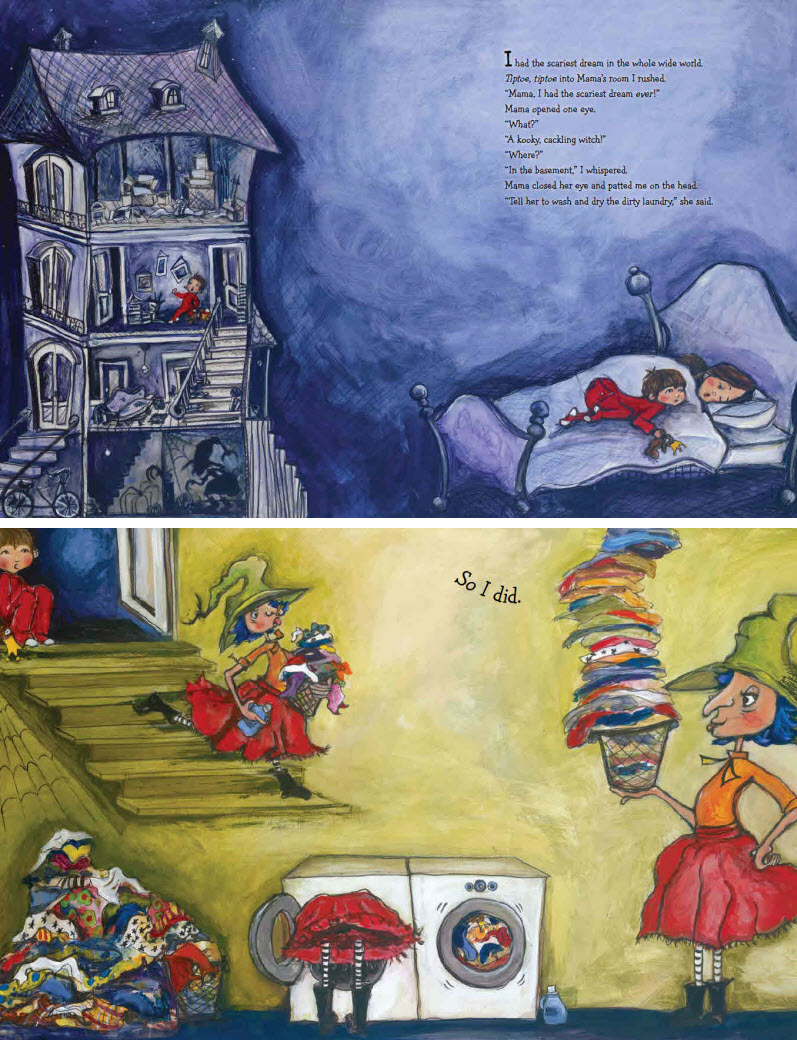
In late September when we were in East Aurora, NY on vacation, the shop windows in the historic village displayed original paintings and text from The Scariest Dream Ever, a children’s book written by Maria T. DiVencenzo and illustrated by Alixandra Martin. We’d arrived in town after the festivities surrounding the Storybook Window Walk, an event to promote the release of the book, but were nonetheless charmed by seeing the shop windows on a quiet Monday morning before the village stores opened for business. A stroll down the street looking at shop windows was like a walk through the pages of the book.

It was amazing to see how the community supported the publication of this book by a local writer and artist so wholeheartedly. At the center of Main Street atop Viddler’s Five and Ten Cent Store, the figure known as “Viddler on the Roof” held a copy of The Scariest Dream Ever high in the air. Viddler’s was one of forty-eight businesses involved in the event. I contacted author Maria T. DiVencenzo who said, “I have worked in the publishing industry for twenty years, and have never before been part of such a unique, creative, charming, and plain old fun event. The support of the community was astounding. The delight of the visitors was unforgettable. Truly a remarkable, spectacular day.”

Artist Alixandra Martin of RedFISH Art Studios and Gallery in East Aurora created the whimsical illustrations for the picture book, and it was these original paintings which were on exhibit in the storefront windows. When I asked DiVencenzo if the displays were still up for Halloween, she responded that they were taken down after about a week, and she made the good point that even though there is a witch in the scary dreams, it is not technically a Halloween book since children have scary dreams all year round. I consider myself lucky to have seen the storybook windows in a serendipitous way as my husband and I strolled down Main Street on our way to get a coffee-to-go at the local coffee shop as we were leaving town.

The book’s message is about the power of imagination. The message of East Aurora’s Storybook Window Walk is about how a community of businesses and merchants came out full force to support and celebrate a project by local artists with pride to help launch the book. DiVencenzo said, “My hope is that events like the Storybook Window Walk, and programs like the Storybook Support Program and HeroConnect (which we just launched last week) will help readers discover our books. With all the talk about the end of ‘books’ . . . I keep trying to remind people that there will always be a place for great stories. Picture books, in particular, must be viewed and appreciated not only as a delightful tool that inspires a love for reading while teaching a child basic skills in reading and understanding context, but as a child’s first exposure to FINE ART. In a world inundated with machines, technology and touch screens, picture books are a hands-on opportunity for our children to view and touch fine art, while being delighted and inspired by it.”

I emphatically agree. The details of illustrations in the children’s books from my own childhood are deeply embedded in my visual memory, as are tactile memories of the way those books felt in my hands as I turned the pages – long before I could make sense of the words on the page, long before I became a reader, and long before I dreamed of becoming a writer.

The Scariest Dream Ever is available at Winterlake Press Web Store, Indiebound, and Amazon.
Bookmark and Share

Sunday, October 24, 2010

Postcards from East Aurora, NY

Taste Coffee, East Aurora, NY
(photo copyright by Dory Adams)

East Aurora, New York was an early destination on our September vacation, where we treated ourselves to a stay at the historic Roycroft Inn as we worked our way toward the Thousand Islands area and Canada. The Main Street shopping district in the village is filled with thriving independent stores and businesses, including a five-and-dime store and a movie theater with neon marquee. It’s the kind of place you notice if you are of a certain age and can remember when the hub of activity used to be in the town – and not at the big box stores or the strip malls outside of town. This is the kind of place you might’ve looked forward to visiting with your parents on a Friday evening or Saturday morning shopping trips. And where, if you were really good and didn’t misbehave, you might be allowed to buy a special treat. These days, the survival of such a downtown business district is the treat. And the one in East Aurora still exists because it was one of the first communities to successfully block Walmart from the area.

Taste Coffee, East Aurora, NY
(photo copyright by Dory Adams)

Taste Coffee’s steaming cup sign appealed to the part of me who forever remains a six-year-old child. It’s an image that reminds me of the episode of Leave It To Beaver where the fire company had to rescue the Beav after he fell into a steaming cup that was part of a billboard advertisement for soup after his pal Whitey dared him to climb up to see if it was filled with real soup. An image is usually all it takes to set a story in motion for me. Or, an overheard snippet of conversation – which is inevitable if you hang around a coffee shop long enough. I was ready to settle in at a table, open up my laptop computer, fuel myself with coffee and see what story unfolded. But we had a long drive ahead of us and we were only there for coffee-to-go as we left town for the long drive to the Thousand Islands area.

Taste Coffee, East Aurora, NY
(Photo copyright by Dory Adams)

I usually prefer to write in a more private space in order to feel secure for that stepping-off from reality that occurs as part of the writing process into the places where a story might take me, but I’m sometimes amazed at how well the writing goes amid the buzz of a busy coffee shop. How about you? Where do you write best?


Bookmark and Share

Sunday, October 10, 2010

Meredith Sue Willis: Out of the Mountains

Meredith Sue Willis is one of those writers whose work is often overlooked – perhaps because she has been labeled as an Appalachian writer. There’s a tendency to categorize writers and books by region or genre, but the result can be limiting in unintended ways. “Appalachian writer” is a term I’ve often used myself to draw attention to the works of writers I admire from that mountain region. But it seems that there may be a stigma associated with being classified as “Appalachian” which lends itself to some widely held stereotypes about mountain people. Why does “Appalachian writer” not have the same cachet as, say, “Southern writer?” After all, Appalachia is a big place and reaches as far south as Mississippi, Alabama, and Georgia. Just as geographic regions can overlap, so can literary genres. A bestselling mystery or legal thriller can also be literary fiction. And, an Appalachian writer can also be many other things as well – including a Southern writer (Bobbie Ann Mason, Lee Smith immediately come to mind).

In the afterword to her new book, Meredith Sue Willis writes, “This collection is called Out of the Mountains because that is where the stories come from, and so do I. . . . One of my projects in writing these stories has been to wonder, with so much slipping into the past, what is still unique about our region. I am also interested in what Appalachians retain and take along when they leave home – when they go out of the mountains – and also what Appalachian attitudes and insights contribute to the larger culture.”

I started reading Meredith Sue Willis’ work nearly a decade ago when one of her short stories had been submitted to me when I was the fiction editor of the literary journal Paper Street. I wanted to publish that piece, but the editor of another journal beat me to it. I was glad to see the main character of that story also appear in several of the stories in Out of the Mountains. In this collection of a dozen stories, characters sometimes reappear in several stories so that the reader sees them at various time points and from different perspectives. However, these are not linked stories. What does connect the stories is a sense of displacement and restlessness – insiders who leave the mountains to live elsewhere and outsiders who come to the mountains. There’s a tension between belonging and not belonging, of insider vs. outsider, of rural vs. urban, of traditional customs vs. new ways.

The cover photograph was taken by my husband, Kevin Scanlon. Both Kevin and I had contributed work to the 2008 “West Virginia Issue” of Hamilton Stone Review which Willis edited. Since Willis was familiar with Kevin’s series of West Virginia photographs, she later requested some of his images for consideration as possible covers for this short story collection. At the time we were curious about why she chose the one she selected, and after reading the stories I now understand how well it fits. These are stories with unexpected juxtapositions and clashes which show the changing culture.

Willis writes, “A great beauty of fiction, of course, is that it can be about many things at once . . . . I consider fiction to be a mutual, human grace – to know people we’ll never meet, beliefs we’ll never hold, experiences we’ll never have in our act
ual lives. It’s what I read for, and why I write.”

Meredith Sue Willis is the author of sixteen books and she teaches creative writing at New York University, School of Professional and Continuing Studies. She also maintains several blogs: Literature and the Web, Online Journal, as well as Resources for Writers. Two of her books have been published this year: Ten Strategies to Write Your Novel (Montemayor Press) and the short story collection Out of the Mountains: Appalachian Stories (Ohio University Press).

Upcoming appearances include the West Virginia Book Festival in Charleston, West Virginia, October 16th – 17th at the Charleston Civic Center and the Kentucky Book Fair, November 13th.
Bookmark and Share

Sunday, September 19, 2010

Nothing Left To Burn

It’s been a long time since I’ve been as excited about a new book as I am for Jay Varner’s memoir Nothing Left to Burn. I was eager to read it after seeing Sal Pane’s review in Pank, where I first learned of the book and discovered that it was by a writer from my hometown of McVeytown in central Pennsylvania – and I was not disappointed reading this fascinating story of a family consumed by family secrets and an obsession with fire. Varner, who earned his BA in creative writing at Susquehanna University and his MFA at The University of North Carolina at Wilmington, crafts a compelling narrative about growing up terrified by his grandfather’s fire fetish. I honestly had trouble putting the book down until I reached the end – and as soon as I finished it, my husband picked it up and also read it in record time.

Farms at the edge of McVeytown, PA
photo copyright by Kevin Scanlon, all rights reserved, used by permission

McVeytown was actually the nearest town to where I grew up. Both my family and Varner’s family had homes in what was known as R.D.#1, outside the village of 400-or-so residents. That area remains fairly ru
ral with lush hill farms nestled between the ridges of Jacks Mountain along the Juniata River. I’ve yet to meet Jay in person, but in such a small community there is only about one degree of separation between everyone. I’ve discovered we have many connections in common, which added a layer of spookiness to reading the book for me. I’d grown up hearing rumors of the fires Jay’s grandfather, Lucky Varner, had set – including the arsons of two homes of his own which burned to the ground.

Fire connects the Varner men. Lucky Varner (Jay’s grandfat
her) was a pyromaniac and serial arsonist. Lucky’s son, Denton Varner (Jay’s father) became the local fire chief. And after Jay grew up, he became a reporter on the local newspaper covering fire and accident reports and writing obituaries.

McVeytown, PA
Photo copyright by Kevin Scanlon, all rights reserved, used by permission

Nothing Left to Burn is filled with twists and surprises and interesting characters. I was curious to learn the inside story about Lucky’s fires, and it was fascinating for me to read Varner’s description of an area I know well. I do not quite see the town as he does, but realize that he experienced life there a generation after me. I’m of his father’s generation, so my experience of living there is probably closer to Denton Varner’s than to Jay’s. No matter which city or state I’ve lived in over the years, I’ve always carried that home place inside me and missed the rhythms of the seasons as marked by the planting and harvesting of crops on the neighboring farms. I haven’t resided there since the mid-1970s, so I still see the town as a charming old village of mostly well-tended lawns and homes, some of which are large stone and brick houses that date to the 1800s. There are hints indicating that things are getting a bit run-down, such as the sign on the post office that is becoming an eyesore (please, someone, restore the missing letters), but the landscape is one of rural beauty. There’s no question about it now being an economically depressed area since many of the long time industries have closed down, including the farm machinery manufacturer where my dad worked his entire life (the same factory that I learned from the book that Denton Varner also worked at for a time).

Post Office, McVeytown, PA
Photo copyright by Dory Adams, all rights reserved

Algonquin, the book’s publisher, issued a newsletter with an interview with Jay about the writing of his book. When Varner was asked how his hometown would react to his book, he responded, “. . . I hope they would be happy that a native son has managed to tell this story. I was careful not to sugarcoat things – I deeply love the town, but leaving out the negatives would do the area an injustice. There are many problems – economic strangulation, educational shortcomings, drug abuse – that must be addressed. However, there are a lot of things that are right and distinctive about the area. And I hope that I have rendered both ends of that spectrum truthfully.” He goes on to say, “My biggest fear is that a protective shroud will befall the town and residents will go on the defensive.”

When asked about his mother who did not want him to write this book, he said, “I’ve done my best to be true to the characters and events. . . . I understand the hesitance not to want this story on bookshelves, but in my hometown, most everyone already knows part of this story to begin with, so I’m not sure much is lost in telling this. . . . However, just as this is my story, it’s also hers, and anyone certainly has the right to be protective of such a thing.” He went on to say, “But in my eyes, it only makes my father a greater man. He gave an awful lot to that town and never asked for anything in return.”

Jay writes of how as a young boy he yearned to spend more time with his father, who was always rushing off to answer fire and ambulance calls. Even though Denton was the fire chief, it was a volunteer position in a volunteer fire company, and he worked a fulltime job as a laborer in a factory to support his family. To young Jay, it seemed that his father was always gone – either at work or at the firehouse. He tells of how his dad was often the first responder to an accident or emergency call, arriving in his pick-up truck even before the ambulance arrived on the scene (he was also certified as an emergency m
edical technician). When I read that, I remembered how when my dad suffered a massive heart attack one Sunday afternoon there was an EMT who arrived in a pick-up truck who came in carrying an oxygen tank even before the ambulance arrived. I’ve since learned that man was Denton Varner.

Jay credits his stint as a reporter for the local newspaper as helping him distance himself enough to tackle difficult topics, saying: “That forced me to hold every story at arm’s length and approach topics with an i
mpartial view . . . to teach me to tackle these memories without such emotional attachment. I was still connected, obviously, but I almost had to look at these events and people as though they were from the life of somebody else before actually understanding how they related to me.” But it was as an undergraduate in creative writing at Susquehanna University, prior to working as a reporter, that he first learned to craft stories. Varner said, “That’s when I saw people could actually examine and confront issues in their life. And I realized that to really understand who I was going to become as a man, I had to examine all that had happened in the past.”

In Nothing Left to Burn, Varner confronts that past – the good and the bad. About his grandfather, Lucky, Jay says: “It’s hard for me to call him simply bad. I think the man had a genuine mental illness with pyr
omania. He may have well been a sociopath too. To me, it was a sickness, not a badness.” About his father, Denton, Jay says: “He was a good man, but ultimately deeply conflicted about the roots of his values. He tried his best but made some poor decisions. Both men were incredibly complex and wrestled with much of that internally. My father wasn’t really torn between becoming a bad or good person, but his priorities were sometimes jumbled due to what he’d experienced as a child. In his heart, he wanted to do what was right.”

Jay’s book has me thinking about communities and our perceptions of home, and about how things constantly change – even in places like McVeytown. It’s true that people there can sometimes be very clannish, separated by geographic, religious and political divides – obstacles any outsider would have difficulty breaking through. It’s interesting that Lucky Varner remained part of that community even though it was common knowledge he was a danger to people’s lives and property – something that would not have been condoned of an outsider. Only an insider could have told this story as Jay has, and he has told it well. He builds a powerful story from ashes by piecing to together what remained – memory, artifacts, and the accounts told to him by others.

Author Jay Varner

• Be sure to watch the book trailer, which is nicely done.

• For a taste of Jay’s writing, read “Farm Machines” online at Quicksilver.

Jay Varner will be appearing at Joseph-Beth Booksellers in Pittsburgh on October 6th at 7 PM. Check out his schedule for appearances in other locations at his website.

Bookmark and Share

Friday, July 2, 2010

Guest Post by Gayle Brandeis: Delta Girls


It’s my pleasure to host a guest post by novelist Gayle Brandeis. (Click on Gayle’s link to the
New York Times article below to see the photog
raph of pears in bottles.)


My novel Delta Girls was originally titled Pears (and is still titled Pears in my heart of hearts.)


I have always loved pears. When I was in third
grade, one of my vocabulary words was “succulent.” I was so excited to come home from school, eat a pear for a snack, and be able to say to my mom, “My, what a succulent pear.” A ripe pear, for me, is the very definition of succulence.

Pears weren’t ever far from my mind as I wrote the novel, which is set, in large part, on an organic pear farm in the Sacramento Delta. Their perfume, their delicate sweetness, their sensuous form. There are few things more beautiful to me than a pear in all its curvy glory.


I was reading the New York Times online one day, and happened upon an article about pear eau de vie. The image of green pears resting inside graceful glass bottles captivated me. There was a gorgeous clarity to
the photos, a delicious simplicity. I decided immediately that the owners of the pear farm had to make and bottle their own pear eau de vie. I needed that image to be inside the book, fresh and vibrant. “An orchard in a bottle,” as the article says. I’ve still never tasted pear eau de vie, but I can imagine its flavor, its bite, as vividly as if I had. The image fills all my senses with its clean, sweet note.

I’ve come to like the title Delta Girls – which was chosen by a team of copywriters at Ballantine – but I was very glad to see two ripe pears hanging at the top of the book cover. There’s even a drawing of a pear on the inside title page flanked with leaves that almost look like wings. Pear as succulent angel, here to save us all.


Gayle Brandeis is the author, most recently, of Delta Girls (Ballantine) and her first novel for young readers, My Life with the Lincolns (Henry Holt). You can find out more about her and her work at www.gaylebrandeis.com.

Delta Girls can be ordered online at IndieBound, Amazon, Powell’s, and Barnes & Noble and is also available in bookstores.


Bookmark and Share

Sunday, December 13, 2009

I Could Use a Box of Words

This week I’ve got nothin’. The well is empty. I have ideas and images for the final two posts of December for Christmas week and New Year’s week, but for this week I’m at a loss. Words fail me.

The photograph above is of the family Scrabble match on Christmas Day 1978. My father-in-law, who was a killer Scrabble player and insisted on at least one friendly game of cutthroat Scrabble at family gatherings, was making what was no doubt a high scoring play. My husband, who snapped this shot and recently came across the negative in his files, said: Look at my tiles, I got nothin’. I feel the same way this week, except I seem to be working with only consonants, as though I’ve been disemvoweled.

Yesterday, a good friend of many years came over for lunch, bringing good stories to share as he always does. Not written stories, but conversational stories told in the be
st tradition of storytelling. We expect that of him, and he knows it. What can I bring, he always asks, and we tell him to just bring a story. No stories, no lunch.

One story he shared was about his box of words, which the nuns at his grammar school made the students keep. I could almost see him as his little boy self carrying his shoebox full of words on index cards to and from parochial school.

I could use a box of words of my own right now.

He at
tributes his spelling ability today to that box of words. Says he can spell almost any word without having to look it up because he had to memorize that box of words. Told of how he recently impressed a coworker by rattling off the spelling of the word egregious without having to look it up.

Man, those were some heavy words those nuns made you carry around, I told him. I’d envisioned words similar to what was in my Fun with Dick and Jane first grade reader. He clarified that egregious was not in his little boy box
of words, but just happened to be the word his coworker was trying to spell. Whew. What a relief.

Despite my love of words, they sometimes fail me. I’ve taken a few runs toward this week’s post, but abandoned them because they felt forced, tedious. The words had no spark. I didn’t love those words. They weren’t accomplishing what I wanted them to do. They lacked the spark of discovery that should accompany the act of writing. And if they sparked no insight for me in writing them, they were certainly not going to light any fires for the reader.

I’ve felt this way before. Felt that I’d written myself out, that the well was dry. It was how I once felt in a workshop led by writers David Jauss and Pamela Painter, facult
y members at Vermont College where I earned my MFA. I admitted to David that I felt empty, that there were no words left, and he smiled knowingly and said: But that’s when you’re getting to the best material. Wells fill from the bottom. It’s where you can tap into the purest source.

Those may not have been his exact words spoken a decade ago, but it’s the essence of what he told me. And he was right. I had a very productive semester following that particular workshop. Now, I no longer panic when I hit dry spells and instead trust that the well is filling from the bottom. Trust that I’m about to tap into something good.

This we
ek I’ve pulled two favorite books on writing craft from my bookshelf: Words Overflown By Stars, edited by David Jauss and Alone With All That Could Happen, written by David Jauss. These essays reassure me of what I already know, remind me of what I’ve forgotten, and teach me what I wasn’t yet ready to grasp before. And best of all, they reconnect me with the very special place of the MFA program at Vermont College, which has recently become the Vermont College of Fine Arts.

Words Overflown By Stars is a compilation of essays from lectures on craft by some of the faculty at Vermont College. Included are many of the fiction writers I worked with there, either in workshop or as semester mentors: Ellen Lesser, Bret Lott, Diane Lefer, Doug Glover, Christopher Noel, Francois Camoin, Sue William Silverman, and David Jauss. Others are by faculty I knew and whose lectures and readings I attended, but didn’t work with directly, such as Phyllis Barber, Victoria Redel, and Syd Lea. Also included are essays by the poetry faculty and by prose writers who were not on faculty while I was there. Take a look at the table of contents.

The title Alone With All That Could Happen is enough in itself to get me writing, just by implying that something will happen if I settle myself down and quiet my mind and let the words come. These are essays that I revisit over and over, each time gleaning something new.

Maybe I don’t need a box of words after all. I have books of words – as inspiration, and to serve as my compass.


News and Updates:

A big thank you goes out to Laura Didyk at She Writes for selecting In This Light as one of the three blogs she reviewed as Curator of the Week there. Her words were particularly meaningful during this week when I was struggling to come up with a new post. In her review of my blog, Laura writes that it “has a truly calming effect. And as a poet who is inspired by images, In This Light makes me want to get out into the world, walk around, and keep my eyes open.” It’s always rewarding to hear the posts have connected with a reader. Please be sure to check out Laura’s own blog, Outloud.

Photo Credit:
“Family Scrabble” copyright © 1978 by Kevin Scanlon, used by permission.


Bookmark and Share

Sunday, November 15, 2009

Lens and Pen as Mirrors: Guest Post by Misko Kranjec

(Click on images for larger view)

[I’m honored to host a guest post this week by Slovenian photojournalist Misko Kranjec. I met Misko in the spring of 2007 when he traveled to the United States to give a presentation at the Center for Railroad Photography and Art’s annual conference. He spent several weeks touring the U.S. on that visit, including a few days photographing in Pittsburgh prior to traveling to the Chicago area for the conference. Misko is an award-winning photographer and the son of writer Misko Kranjec. ~ Dory]


Lens and Pen as Mirrors

When Dory invited
me to write a short reflection of how my father, a prominent Slovenian writer, and his writing influenced my photography, I thought it would be a piece of cake – a few sentences, blah, blah blah, and voila – done. This was not because I would undervalue Dory's blog and her endeavor in any way; I was just overestimating my capacity to analyze myself, and in English on top of that.

Actually, I never gave much thought about my own photographic aims – the concepts and inner meanings, or the mission of my work. I was just an observer of the world with the camera, recording what attracted my eyes and triggered my feelings. I didn't make a fuss of my efforts. For me, photography was always fun, and throughout the 30 years of my photojournalistic career, I always tried to keep it this way.

My father was a prominent writer in his time, kind of a Slovenian Faulkner, writing about Prekmurje – that northeastern region squeezed between Austria, Hungary, and the Mura River – and of the people living there. At the time of his birth in 1908, this region still belonged to the Hungarian part of the Austro-Hungarian Empire, but after the First World War it was associated to the new born Kingdom of Yugoslavia.

Totally rural and without any industry worth mention, this region was extremely poor. Half of it was either swamp or covered with thick forest, most of it belonging to the Hungarian Count Zichy family who had a castle in Beltinci and owned the biggest part of the arable land. What was left was far from being capable of sustaining the peasants living there, so the men either temporarily left their families to work as seasonal hired help in other parts of Yugoslavia or abroad, or whole families immigrated, mostly to the United States, Canada, or to the countries in South America.


After the WWII and with the birth of the Socialist Republic of Yugoslavia, the last of the Zichy Counts, the Countess Maria Zichy, fled to Austria. The land and the castle were confiscated and turned into a state farm. The swamps were mostly dried and turned into fields or grazing land and divided among the farmers. Significant progress came to this region and several factories were built, yet the region still remained predominantly rural, underdeveloped, and poor. What money came in was mostly from those working temporarily in Austria, Germany, and
France.
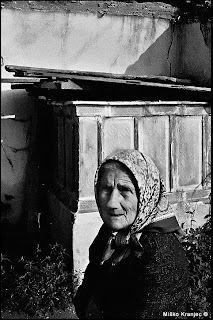

However poor they were, the people living in Prekmurje were extremely friendly and open, willing to invite even a stranger into their modest homes and share with him the last loaf of bread and the last bottle of home-grown wine. Those were the people and the land my father wrote about, and when I started with my photography back in the early 1970s, the scene there was pretty much the same as it had been decades earlier. While many new houses had been built, and cars and tractors started to emerge in ever greater numbers, there were still numerous clay-plastered wooden cottages with thatched roofs, carts and plows were still draw by cows, and the farmers, especially the women, still dressed as they did a century ago.


All this gave me a great opportunity to record on film at least a bit of
what my father wrote about in his novels. True, the scene was changing rapidly and it took some careful framing to avoid the signs of modern times in order to record it as it had appeared in the past. Perhaps I could even be accused of deliberately twisting the truth, but in this case it was not the truth or the present I was aiming for, but rather the past – the world of my father which gave him so much inspiration and so many stories and human destinies to write about.

Disappointed with my first attempts to write about this for Dory’s blog, I decided to steal from my father by translating from the beginning of his book Y
outh in the Swamp, one of his last novels which is actually a biography of his childhood. So I started to translate this part of his book, and became too excited with my doing it to stop. Some of my father's work has been translated in several languages, but none in English. In front of me was my father’s book about his youth in this poor land, and on the very first inner page, before the title, written in his handwriting was inscribed: To my son Misko, as the mirror to the long gone days. January 15th, 1963. I was sixteen at that time, and little did I know that one day I’d be holding a mirror of my own – the camera.


As a kid, I was often in Prekmurje. During the summer holidays my father would take me with him whenever he would go there to write in the house that he, my mother, and his brother had built before World War II, which replaced the thatched-roof cottage where he was born. Back then, I didn't even like Prekmurje very much. We would stay there for tw
o or three weeks, and these were very long and boring weeks for me. I was a city boy, and at home I had friends that I would play with the whole day long, every day in summer. But in Prekmurje, I had no other friend but the son of the school master. All the others were peasant kids, who spoke a dialect I could hardly understand. While my father was writing, I was left to my own devices which meant mainly reading books, playing with my toys, and feeling lonely and bored. In fact, I hated Prekmurje then.

Years later, during my leave from army service,
I happened to visit Prekmurje for a day, and there I met a lovely girl who would inspire about a hundred love letters, and later she became my wife. With that moment, my eyes viewed this land in a totally different light. We visited relatives there at several times a month, and her home became the base for my photographic explorations. Even though it was in the early 1970s, modern times had not yet really touched this remote land. The old people, the old cottages, and the old way of living – everything in fact that my father had written about in his books – was still very much present. I was just taking my first serious, formative steps into photography then, and my father's world suddenly became a great subject for my camera. It also became very, very close to my heart.


I may have thought I hated this land as a kid, but actually I was soaking its spirit into my blood. The love for it and for its people had been hidden within me, but as I photographed, those feelings and affection surfaced. The people of my father's books were suddenly there, in blood and flesh, standing in front of me, speaking to me, inviting me into their homes, offering me their wine and food. Just as the people had come to life, so had the words my father put onto the page – all with new meaning.


Looking through the viewfinder, I felt them in my mind and they spoke to me and guided my eye while I was framing, and even then I did not yet realize that I was holding a mirror to those long gone days too. Yes, they were still there, as though frozen in time, not really the past yet – but it was fast thawing and running out.


Today, I am happy I had the chance to record the last remains of this world. In less than a decade the scene changed completely - the lovely old cottages were replaced with the modern houses, big John Deeres replaced the cows, and the old people died, one by one. In the mid-1980s there was almost nothing left of the old Prekmurje to photograph, and what remained was mostly weed-grown ruins.

I don't know whether it was an omen, destiny, or just coincidence that my father died in that same time. Unfortunately with his death also started the process of the oblivion of his work, more or less triggered by events which followed the secession of Slovenia from Yugoslavia in 1991. This was a time when the regime here changed to the right, to the conservative side, which considers my father as a "red" writer, writing foremost about the poor and deprived but good-at-heart people, the peasants from his Prekmurje, and because he openly favored socialism. Not a single book of his has been reprinted since his death, and I can openly say he was deliberately pushed into this state of oblivion.

Well, actually not quite, as last year was the 100th anniversary of his birth and suddenly he was remembered again – for a brief moment. The Association of Slovenian Writers organized a literary evening, held in one small auditorium of the big cultural center in Ljubljana, where writers and poets from Prekmurje read their works in honor of my father. Five days before this event, one of them remembered that I had photographed Prekmurje extensively and thought it would be good to show my photos during the reading.

They asked if I would prepare a photo show. At first I refused, as this would mean scanning and retouching many photographs from negatives that I hadn’t held in my hands for at least 25 years. I calculated I would need between 300 and 400 images for a two hour event, to be shown on a screen during the reading. However, after more thought, I changed my mind. First, because of my father; I said to myself, I owe him this. And second, because of me; it had been a while since I’d had an exhibition of my photographs, and I told myself, it is always good to show people you are still around, important to defy oblivion.

[To see more of Misko's Prekmurje photographs, visit his online gallery.]


Photo Credits: All photographs copyright Misko Kranjec, used by permission.


Bookmark and Share