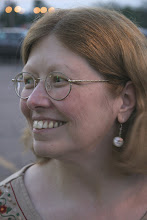
Los Angeles Union Station courtyard, 1979
Copyright by Kevin Scanlon, all rights reserved,
used by permission
That's me in the picture, which was taken in 1979 at Union Station in Los Angeles. This photograph came to mind because I’ve been thinking about reminiscent narrators and journeys as part of the novel I’m writing. When I look at that image I see a girl headed into unknown territory, taking a break at a brief stop on the way to her destination – looking forward, not back.
Much has changed since those youthful days, including the story I might now tell about the journey north along the edge of the Pacific on the Coast Starlight. Back then, I was on the verge of making some important decisions, thinking only of the future. Now, I look back on that time with layers of knowledge that only experience and hindsight can provide to inform the past.
Writer Ellen Lesser, who was one of my mentors in the MFA program at Vermont College (now known as The Vermont College of Fine Arts), wrote an excellent essay on reminiscent narration. Lesser's article "The Girl I Was, The Woman I Have Become: Fiction's Reminiscent Narrators" originally appeared in The Writers Chronicle and has since been reprinted as one of the essays included in Words Overflown By Stars, which was edited by David Jauss (who was also one of my workshop teachers at VCFA). Ellen wrote the essay after noticing in workshop that "about half the submissions cried out for some added insight, of the sort a retrospective stance on their events could provide. The other half were set up as remembrances but never made particular use of the vantage point; some even appeared to forget, a few pages or paragraphs in, that their protagonists were gazing backward. It struck me that our developing writers had agonized over whether to narrate in past or present tense, in first or third person, but they'd approached this other crucial decision – the point in time from which the story gets told – at best casually, with little reflection." Lesser goes on to ask some important questions that every writer should consider about the use of reminiscent narration, and she looks at examples in the work of Kazuo Ishiguro, Alice McDermott, Edna O'Brien, Lynne Sharon Schwartz, Jane Smiley, and W. D. Wetherell. I highly recommend this book, which I also wrote about here.
In telling the story that goes with the photograph now, I might choose to reveal some things beyond the frame of that rainy morning in the station courtyard. I could flash forward and back by decades, layering in whatever is relevant to the story I want to tell. What I’d say now might be very different from what I’d have said in 1979. Even if you are familiar with that grand Art Deco station, and even if you’d once sat on that very same bench back in 1979, you couldn’t know what I was seeing or thinking about as I sat there smoking that cigarette. There are things even I couldn't know then that would add depth and meaning to the story – for instance that this would be the only train ride I'd take on the Coast Starlight. Or, that I'd soon give up cigarettes forever. Or, that I'd marry the guy who took this picture. It's all about framing and perspective. Distance, and finding exactly the right point in time for the telling.
 Los Angeles Union Station, 1979
Copyright by Kevin Scanlon, all rights reserved,
used by permission


 Posts