Mural, Gauley Bridge Photo copyright by Kevin Scanlon, all rights reserved
Book cover design choices fascinate me. Those cover illustrations are what make browsing in a bookstore so pleasurable – they lure us to pick up a particular book for a closer look, flip it over to read the back cover, open it up to read the inside jacket flap. At least that’s how I browse. Only after I’ve examined the front cover image, the back cover, and the inside flap do I open the book to the first page to read the first sentence. If that opening sentence pleases me, I may even reread it with the entire first paragraph. If I’m not hooked by then, the book goes back on the shelf.
I was already familiar with the cover image for the new short story collection, OUT OF THE MOUNTAINS, by Meredith Sue Willis. I happened to be with Kevin Scanlon in the town of Gauley Bridge, West Virginia, the day he photographed the mural at the center of town. When I learned one of those images was chosen as the cover for the book, I was already hooked. But I want you to be hooked, too, because this is a beautiful collection of stories. So, I’ll open the book for you to the first story, “Triangulation,” so that you can be hooked on that first sentence and paragraph:
“There is a process in navigation by which you locate an unknown point by forming a triangle between it—where you are standing now, for example—and two known points. From time to time, we use great events in history in this way. That was the year I got married and also the year of the great blackout. Where were you when the president was shot? When the towers fell?”
IN THIS LIGHT blogger Dory Adams asked me how I chose the particular photograph we used for the cover of my second collection of Appalachian stories, Out of the Mountains, from Ohio University Press. The photo is by Dory’s husband Kevin Scanlon, and I had seen his work earlier on the internet, and used several of his images of West Virginia trains and cars and landscapes in Issue 16 (Fall 2008) of The Hamilton Stone Review. The combination of trees and hills and steel and cars and mist and old frame buildings moved me intensely: it’s the Appalachia and West Virginia that I knew growing up – mine tipples and coal cars on high trestles and always in the background the green humpy hills. So I think what I wanted for the cover of my book was actually a whole slew of Kevin’s images. One that I especially liked had a little girl on a bike and some houses and a train passing way overhead, but the folks at Ohio University Press were concerned about the legalities of images of children, and, as I said, it wasn’t any single image I was stuck on, but just the sensibility of his work.
Now here’s the funny part: I don’t really remember choosing the image of the car in front of the Gauley Bridge mural that was ultimately used. It is an image with the slightest touch of an edge, that is, the question of what is real and what is super-realism– are we looking at a real car or a painting of a car? And of course, in actual fact, we’re looking at a piece of glossy printed cardboard, not a car of all, when we look at the book, or some pixels on a CRT or LCD screen if we’re looking online.
The head of publicity at Ohio University Press says that she’s the one who made the final pick, which she cleared with me, of course. And as I said, it was one of many images that moved me, so I was fine with it.
What pleases me about it is both the edge and the insistence on the art of the photograph as well as the art of the mural. I’m generally a realistic writer, but what’s the point of literature if it isn’t artful? So the art and the calling attention to art worked for me, but so did the old car, and its implications of coming and going, and the mural as a tourist attraction.
And, really, I just adore Kevin’s photos.
Meredith Sue Willis will appear at the Kentucky Book Fair November 13th, 2010 at the Frankfort Convention Center, 405 Mero Street, Frankfort, KY. Hours are 9:00 a.m. to 4:30 p.m. Admission is free.
Taylor Books in Charleston WV, photo copyright by Kevin Scanlon, used by permission
We’ve just returned from a spur-of-the-moment trip to Charleston, West Virginia for the West Virginia Book Festival. Despite a newly-suffered knee injury, the lure of an autumn weekend getaway was just too tempting – especially since I’d have the chance to attend Meredith Sue Willis’ workshop on Saturday and a reading by Jayne Anne Phillips on Sunday.
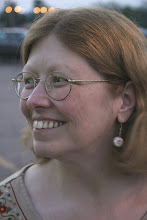
Meredith Sue Willis at West Virginia Book Festival, photo copyright by Dory Adams
We packed our bags, grabbed our cameras, and drove south. These spontaneous road trips often turn out to be some our best journeys because everything sort of unfolds as we go. No planning, no expectations – no disappointments. We stopped to buy a cane and a knee brace along the way, and on Saturday morning I hobbled through the book fair as best I could. We arrived in time to visit a few of the exhibits before the workshop started, so we browsed at the book tables of West Virginia University Press and Ohio University Press. Meredith Sue Willis’ workshop “Ten Strategies to Write Your Novel” was popular and well-attended, the room filled to capacity. What a pleasure it was to finally meet this wonderful writer who already seems like an old friend. After the workshop, Kevin took another stroll through the exhibition hall while I sat in the lobby to rest my knee. He returned with some unexpected finds: first editions of Chuck Kinder’s Snakehunter and Richard Currey’s The Wars of Heaven, both with dust jackets and in nice condition.
Taylor Books Cafe, photo copyright by Kevin Scanlon, used by permission
A trip to Charleston is not complete without a visit to Taylor Books, which is one of my favorite bookstores of all time. The bookstore, gallery annex, and café are in connected buildings with common floor space. Taylor Books has everything: a nice stock of fiction, nonfiction, poetry and children’s books; a large selection of magazines and periodicals; an art gallery; an art studio; a coffee shop with fresh baked scones and other pastries (baked by the owner, Ann Saville); tables and comfy chairs; and a knowledgeable staff. They even have squeaky wood floors to provide the ultimate bookstore browsing ambience. Best of all, Taylor Books values West Virginia’s writers by keeping their books in stock and on display – something you won’t find at a chain store (where the shelf-life of a newly published book these days, as Meredith Sue Willis said in her workshop, is less than that of yogurt).
View from gallery to bookstore and cafe at Taylor Books, photo copyright by Kevin Scanlon, use by permission
While I sipped a coffee, nibbled at a lemon bar, and perused a stack of books at my table in the coffee shop, Kevin shot the photographs for this week’s postcard from the road. We listened to the live music (Taylor’s has live music in the café Friday and Saturday evenings) and then made a few purchases. I knew I needed to get back home to Pittsburgh and take care of my knee, and that meant we were going to have to skip Jayne Anne Phillips’ reading on Sunday. The disappointment of that was eased by finding a brand new signed first edition of her 1994 novel Shelter at Taylor’s. That’s how it is with spontaneous journeys – you have to roll with it, and take great pleasure in the unexpected finds.
Taylor Books Cafe, photo copyright by Kevin Scanlon, used by permission
If your travels take you to Charleston, WV, be sure to visit Taylor Books, located at 226 Capitol Street. It’s definitely a destination in itself – and worthy of postcards from the road.
Meredith Sue Willis is one of those writers whose work is often overlooked – perhaps because she has been labeled as an Appalachian writer. There’s a tendency to categorize writers and books by region or genre, but the result can be limiting in unintended ways. “Appalachian writer” is a term I’ve often used myself to draw attention to the works of writers I admire from that mountain region. But it seems that there may be a stigma associated with being classified as “Appalachian” which lends itself to some widely held stereotypes about mountain people. Why does “Appalachian writer” not have the same cachet as, say, “Southern writer?” After all, Appalachia is a big place and reaches as far south as Mississippi, Alabama, and Georgia. Just as geographic regions can overlap, so can literary genres. A bestselling mystery or legal thriller can also be literary fiction. And, an Appalachian writer can also be many other things as well – including a Southern writer (Bobbie Ann Mason, Lee Smith immediately come to mind).
In the afterword to her new book, Meredith Sue Willis writes, “This collection is called Out of the Mountains because that is where the stories come from, and so do I. . . . One of my projects in writing these stories has been to wonder, with so much slipping into the past, what is still unique about our region. I am also interested in what Appalachians retain and take along when they leave home – when they go out of the mountains – and also what Appalachian attitudes and insights contribute to the larger culture.”
I started reading Meredith Sue Willis’ work nearly a decade ago when one of her short stories had been submitted to me when I was the fiction editor of the literary journal Paper Street. I wanted to publish that piece, but the editor of another journal beat me to it. I was glad to see the main character of that story also appear in several of the stories in Out of the Mountains. In this collection of a dozen stories, characters sometimes reappear in several stories so that the reader sees them at various time points and from different perspectives. However, these are not linked stories. What does connect the stories is a sense of displacement and restlessness – insiders who leave the mountains to live elsewhere and outsiders who come to the mountains. There’s a tension between belonging and not belonging, of insider vs. outsider, of rural vs. urban, of traditional customs vs. new ways.
The cover photograph was taken by my husband, Kevin Scanlon. Both Kevin and I had contributed work to the 2008 “West Virginia Issue” of Hamilton Stone Review which Willis edited. Since Willis was familiar with Kevin’s series of West Virginia photographs, she later requested some of his images for consideration as possible covers for this short story collection. At the time we were curious about why she chose the one she selected, and after reading the stories I now understand how well it fits. These are stories with unexpected juxtapositions and clashes which show the changing culture.
Willis writes, “A great beauty of fiction, of course, is that it can be about many things at once . . . . I consider fiction to be a mutual, human grace – to know people we’ll never meet, beliefs we’ll never hold, experiences we’ll never have in our actual lives. It’s what I read for, and why I write.”
Upcoming appearances include the West Virginia Book Festival in Charleston, West Virginia, October 16th – 17th at the Charleston Civic Center and the Kentucky Book Fair, November 13th.
Last week The Millions ran an interesting article, “In Our Parents’ Bookshelves” by Kevin Hartnett, about the effect E-readers will have on the books people buy in hard copy vs. electronic version and how that will have an impact on what we see on personal bookshelves. Hartnett realized while watching his young son play with a pile of books that “the clunky objects he was playing with seemed like relics.” Bookshelf contents reveal much about their owner. After examining the books on the shelf in his mother’s bedroom at the house where she’d grown up, Hartnett describes them as resembling “a type of monument.” He writes, “I got the clearest glimpse I ever had of my mother as a person who existed before me and apart from me, and whose inner life was as bottomless as I knew my own to be.”
I do not yet own an E-reader, but I imagine that day is not far off. I already buy Kindle downloads for my iPod Touch. I downloaded the free app for iPods last year while recovering from hand surgery, during a time when it was difficult for me to hold a book. I read my first Kindle books holding the iPod in my good hand while my other hand was immersed in the fluidotherapy machine at physical therapy.
I’m not an earlier adopter of gadgets, however, simply because I don’t have the discretionary income to be one. My budget tells me I have to wait to see what the best option will be, and it’s still too early to tell. I want an E-reader that will allow me to make annotations onto the page as the Kindle does, yet I’m reluctant to buy a Kindle simply because I’m leery of having a bookseller as powerful as Amazon have that much control over what is published and how it is stored (and considering how Amazon went about removing Orwell’s 1984 from Kindles last year – copies which the Kindle owners had purchased – that is a serious concern). I was counting on Apple to come up with an E-reader that would dazzle me, but the iPad seems not much more than I already have with my iPod. In fact it even looks like a big iPod – maybe too big. I want an E-reader that is light in weight that will fit in my purse, something about the size of a trade paperback.
One reason an E-reader appeals to me is simply that I’m running out of space for more bookshelves. We’re at a point in our lives where we should be downsizing, but if we bring many more books home we’re going to need to build on an addition just for books. I’m thinking of attaching a silo as a circular library equipped with a very tall ladder. Seriously. I once saw a photograph of one and immediately asked Kevin, “Can we get one? Huh? Huh? Can we get one this weekend?”
I’ve loved books since I was a very young girl. My grandmother had a bookcase in her living room filled with Book of the Month Club editions, which I now realize must have been a huge luxury considering my grandparents’ income. They lived in a very small town in the mountains where the nearest library was twenty miles away. Before I could read, I used to take books from Grandma’s bookcase and turn the pages, amazed that those black markings on the page were words that held a story – knowing that someday I would be able to read them myself. Grandma had grown up in a house with a library room, which I remember well from visits to my great-grandmother’s house. The library table from her house is now in my own home. I used it for many years as a desk, but now keep it in the guest bedroom where the bottom shelf of that table is filled with stacks of books I haven’t found shelf space for yet.
In the small house where I grew up, my parents didn’t have many books of their own. They subscribed to Life and Look, though, and I suspect that looking at the photographs in those glossy magazines had an influence on me wanting to study photography later. After my dad’s retirement he had more leisure time to read, and he then bought books on history and religion which began to accumulate in their house.
The first bookshelf of my very own was built into the headboard of my bed, and I gradually filled it with books from the Nancy Drew and Trixie Belden series, as well as paperbacks from Scholastic Books which were available for students to buy through our school. But most of the books I read as a pre-teen were borrowed from the local library, which my mom drove me to during the summer months when I couldn’t get books from my school library.
When I was a teenager, my dad built a pine bookcase for me which I quickly filled with paperback copies of favorite books, To Kill a Mockingbird, Catcher in the Rye, and The Yearling among them – as well as more popular best sellers of the time such as Love Story, which all the girls at school were reading. Someone searching through my bookshelves back then would’ve seen a mind trying to figure out her place in the larger world – moving from fashion and advice in magazines such as Ingénue and Seventeen, to the novels of Hemingway and the Bronte sisters, and back to teen idol magazines such as Tiger Beat and 16 Magazine (hello David Cassidy) until I outgrew and replaced them with Rollingstone Magazine (hello James Taylor and Jackson Browne).
College friendships were formed in part by seeing what LPs (those were the final vinyl days) and books were on someone’s shelves and determining what interests we shared, and by seeing what new books and music their interests opened up to us. Now, books are about to go the way of LPs and CDs. Have you noticed how small the music section is getting at stores lately? No? Perhaps you’ve stopped browsing and shopping there too, just as happy to purchase and download the files from iTunes for your iPod.
When Kevin and I first joined our lives together and were barely eking out a living in San Francisco back in the late 1970s, one of the first pieces of furniture we purchased was a bookcase. This was not a bookcase we bought in a store, but rather one that Kevin built after borrowing tools to cut and sand the planks of pine we carried home from the lumber store. We didn’t have a car back then, but somehow managed to get the lumber home on a Muni bus – the 38 Geary, to be exact. Those were the days! Our other furniture had been borrowed from his sisters, but that bookcase was ours. We filled it with used paperbacks we bought for about a quarter apiece at Green Apple Books, which I’m happy to say is still in business and still in the same location on Clement Street.
What my bookshelves reveal about me today would depend on which bookcase you were inspecting. We have books in nearly every room of the house, including the basement. In the study, which Kevin and I share and is the room where we spend most of our time, there are three long bookshelves above our desks. The bottom shelf is filled with reference books and books on writing craft, the upper shelves filled with novels. Lining the top of the credenza are oversized volumes, mostly photography books. In the living room is an oak bookcase with glass doors containing the signed and inscribed books we’ve acquired, many of them by West Virginia writers. That bookcase also holds most of our Beat writer collection, as well as numerous talismans related to the imagery in the novel I’m working on – a miner’s head lamp and coal mine core samples, a mastodon tooth (which can be seen on the shelf in front of the Kerouac books) and various other fossils too fragile to keep on my desk.
Kevin Hartnett closes his article by saying, “It remains to be seen how many more generations will have the adventure of getting to know their parents this way. . . To the extent that bookshelves persist, it will be in self-conscious form, as display cases filled with only the books we valued enough to acquire and preserve in hard copy. The more interesting story, however, the open-ended, undirected progressions of a life defined by books will surely be lost to a digital world in which there is no such thing as time at all.”
What do your bookshelves reveal about you? In what ways do you think the new digital book technology will change how you read and acquire books?
Around the Blogosphere:
A Conversation with Irene McKinney Watch Kate Long’s wonderful interview with West Virginia poet laureate Irene McKinney on YouTube (WV public broadcasting). Part 1 is here. I love hearing these two distinctive regional West Virginia accents as they discuss McKinney’s work and the discoveries which come out of the writing process itself. More than twenty years ago after earning her PhD, McKinney returned to her home place in West Virginia to finish two books of poetry while on a six-month sabbatical from the university where she was teaching in New York. She ended up moving back to West Virginia permanently. From the window of her home, she can see the house and barn that were her home place. The house she built is filled with books, which you can see in parts 2 and 3 of the interview (note to self: stop worrying about space for additional bookshelves, just start stacking them on the floor). I’ve long admired McKinney’s poetry, and have mentioned Kate Long’s radio series In Their Own Country (which includes an interview with McKinney) in previous posts here at In This Light. McKinney reads several of her poems in the interview and speaks of the memoir she is writing, which she calls “a memoir of place” because she believes describing the region and people she comes from is the best way to say who she is. (link via Meredith Sue Willis)
Literature and the Web Meredith Sue Willis has launched a new blog, Literature and the Web, and the latest edition of her Books for Readers is now posted online. Information on upcoming appearances and her two new books, Out of the Mountains: Appalachian Stories from Ohio University Press, and Ten Strategies to Start Your Novel from Montemayor Press, both to be released in summer 2010 can be found here.
Lee Maynard’s latest book is his best yet. Described as “autobiographical fiction” by West Virginia University Press, it is a road trip that is part interior journey and part physical exploration of the landscape – West Virginia’s hills and hollers, the Sea of Cortez, the desert of New Mexico, and the arctic tundra. Opening with Maynard’s birth in 1936 in the parlor of his grandmother’s home, very short chapters polished like gems cover most of his lifetime between 1941 and 2005.
I immediately connected with the childhood chapters, feeling a kinship in the way that I do with so many Appalachian writers – and those from West Virginia in particular. The best writers have a way of making us think about our own lives through their stories, and the early chapters of The Pale Light of Sunset had me thinking about my own growing up on Jacks Mountain in central Pennsylvania. Maynard’s chapters are short in length, but long on thought – for both the writer and the reader.
Fellow West Virginia writers give The Pale Light of Sunset high praise. Ann Pancake describes the chapters “Arrow in the Light” and “A Death in the Mountains” as “miniature masterpieces” that “chilled my skin in awe.” Richard Currey describes the stories as “infused with a wanderer’s soul” and calls the book a “narrative of the mind and spirit for our own time.” Meredith Sue Willis describes the book as a “fictional memoir – a kind of heightened and imagined life” and says “Lee Maynard writes better than anyone else I know about how a boy is infused with the rules of American manhood.”
I had the good luck of hearing Lee Maynard read in 2003 at the Quiet Storm in Pittsburgh, as he and friend Chuck Kinder set out on their “Outlaw Writers Tour” along with the alt-country band The Deliberate Strangers. Both had new books out: Maynard’s Screaming with the Cannibals and Kinder’s The Last Mountain Dancer.
Maynard had already achieved notoriety with his first book, Crum, which was pretty much banned in his home state of West Virginia. In fact, Tamarack slapped “Adult Content” stickers on two of my favorite books which I bought there after finding them shelved low and in a very dark corner: Chuck Kinder’s Mountain Dancer and Keith Maillard’s Gloria. When I met Keith Maillard a few years back and asked him to sign that copy, he was startled by the neon green adult content sticker slapped on the cover, and gasped “What’s this?” I explained about where I’d bought it and told him not to worry because he was in very good company on that bottom corner bookshelf. When I asked Chuck if he was offended by Tamarack’s actions, he said he’d be offended if they hadn’t put a sticker on his book.
But back to Lee Maynard’s new book. The foreword “I’m still here, Lowenstein, you son of a bitch” intrigued me and by the end of the first chapter “The Parlor” which was barely three pages long, he’d totally hooked me. At times I wanted to savor a particular chapter by putting the book aside and losing myself in thoughts about it, but the momentum of the story propelled me to the next chapter and I could not put the book down for long. I connected most with the early childhood chapters and the later chapters. The rowdy and bawdy young manhood years were interesting and surreal with film noir shadings, and they worked well to make the later chapters all the more poignant. By the end – all the rivers crossed, all the running away from and toward something, all the small details as simple and significant as a treasured button – all those short chapters covering a lifetime of decades add up to one hell of a story. One of my favorite chapters, “1948: My Mother’s Coat” is about grasping the sense of loss. After running away for the day, Maynard returns home in the evening to find his mother gone: “I charge through the small rooms, breathing the scent of her, knowing that she has been here, waiting for me. There is no fire in the stove and the house is chilled. She is gone. Without her, the house has no meaning.” Another favorite chapter late in the book, “2003: Where I’m From,” is about the images that come to mind as the essence of the West Virginia landscape.
On the page following the dedication, there is a wonderful quote by Lee’s good friend Chuck Kinder: “All Stories are true, if they are well written. The question is what they are telling the truth about.” The stories in The Pale Light of Sunset are truths that I will carry with me for a very long time.
Additional Links:
You can see and hear Lee Maynard talk about The Pale Light of Sunset in this WVU Press podcast.
The publication of this week’s guest post will be delayed until Monday. Please check back tomorrow evening for a guest post by Slovenian photojournalist Misko Kranjec.
In the meantime, this gives me a chance to add a post about the recent Best Books of 2009 top ten list from Publisher’s Weekly. You’ve no doubt heard the outcry that not a single woman writer was named on the list. Kamy Wicoff, Founder and CEO of She Writes (of which I am a member), posted a wonderful editorial emphasizing her outrage at PW’s justification for coming up with a list that was not only exclusively male, but also 90% Caucasian.
There have been a flurry of posts at She Writes in response to Wicoff’s call to action, including one by writer Cathy Day about branding and book jackets as part of the literary gatekeeping.
In regard to the Publisher’s Weekly list, I can only shake my head in amazement that Jayne Anne Phillips’ Lark & Termite was not included. Phillips is the featured author in the winter 2009 issue of Appalachian Heritage, where you can read an excellent profile of her by another West Virginia writer, Meredith Sue Willis.
"Arrange what pieces come your way." ~ Virginia Woolf
About This Blog:
In This Light is a blog about the influence of images on writers and writing. Think of it as a place where imagery joins narrative, to see how things look through the light of words.
I live and write in Pittsburgh, PA and have a diverse background with degrees in photography and psychology, as well as an MFA in writing from Vermont College. I prefer to think of this as the winding path toward writing -- a journey where interests in image and human behavior converged as story.
My work has appeared or is forthcoming in Connotation Press, Now & Then: The Appalachian Magazine, The Santa Fe Literary Review, The Avery Anthology, Hamilton Stone Review, Blue Earth Review, Hobart, Slipstream, Forge, Word Riot, The Oklahoma Review, Common Ground Magazine, Shalla Magazine, and Paper Street. My story "Tests and Measurements" which appeared in Workers Write! Tales from the Clinic was nominated for a Pushcart Prize in 2009.
 Mural, Gauley Bridge
 The head of publicity at Ohio University Press says that she’s the one who made the final pick, which she cleared with me, of course. And as I said, it was one of many images that moved me, so I was fine with it.


 Posts
Posts