Showing posts with label writing process. Show all posts

Sunday, March 27, 2011

Looking Forward, Looking Back: “The Girl I Was, The Woman I Have Become”

Los Angeles Union Station courtyard, 1979
Copyright by Kevin Scanlon, all rights reserved,
used by permission

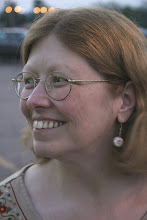
That's me in the picture, which was taken in 1979 at Union Station in Los Angeles. This photograph came to mind because I’ve been thinking about reminiscent narrators and journeys as part of the novel I’m writing. When I look at that image I see a girl headed into unknown territory, taking a break at a brief stop on the way to her destination – looking forward, not back.

Much has changed since those youthful days, including the story I might now tell about the journey north along the edge of the Pacific on the Coast Starlight. Back then, I was on the verge of making some important decisions, thinking only of the future. Now, I look back on that time with layers of knowledge that only experience and hindsight can provide to inform the past.

Writer Ellen Lesser, who was one of my mentors in the MFA program at Vermont College (now known as The Vermont College of Fine Arts), wrote an excellent essay on reminiscent narration. Lesser's article "The Girl I Was, The Woman I Have Become: Fiction's Reminiscent Narrators" originally appeared in The Writers Chronicle and has since been reprinted as one of the essays included in Words Overflown By Stars, which was edited by David Jauss (who was also one of my workshop teachers at VCFA). Ellen wrote the essay after noticing in workshop that "about half the submissions cried out for some added insight, of the sort a retrospective stance on their events could provide. The other half were set up as remembrances but never made particular use of the vantage point; some even appeared to forget, a few pages or paragraphs in, that their protagonists were gazing backward. It struck me that our developing writers had agonized over whether to narrate in past or present tense, in first or third person, but they'd approached this other crucial decision – the point in time from which the story gets told – at best casually, with little reflection." Lesser goes on to ask some important questions that every writer should consider about the use of reminiscent narration, and she looks at examples in the work of Kazuo Ishiguro, Alice McDermott, Edna O'Brien, Lynne Sharon Schwartz, Jane Smiley, and W. D. Wetherell. I highly recommend this book, which I also wrote about here.

In telling the story that goes with the photograph now, I might choose to reveal some things beyond the frame of that rainy morning in the station courtyard. I could flash forward and back by decades, layering in whatever is relevant to the story I want to tell. What I’d say now might be very different from what I’d have said in 1979. Even if you are familiar with that grand Art Deco station, and even if you’d once sat on that very same bench back in 1979, you couldn’t know what I was seeing or thinking about as I sat there smoking that cigarette. There are things even I couldn't know then that would add depth and meaning to the story – for instance that this would be the only train ride I'd take on the Coast Starlight. Or, that I'd soon give up cigarettes forever. Or, that I'd marry the guy who took this picture. It's all about framing and perspective. Distance, and finding exactly the right point in time for the telling.


Los Angeles Union Station, 1979
Copyright by
Kevin Scanlon, all rights reserved,
used by permission


Bookmark and Share

Sunday, March 20, 2011

Salvage: Rescue, Recover, Reclaim

"Antique Junk" (photo copyright by Dory Adams)

I’m deep into the mess that is my novel-in-progress, work which had been temporarily shelved more times than I care to remember. I’d fallen into a habit of working on it in fits and starts, waiting for larger blocks of writing time to immerse myself more fully in the writing. Guess what – it will never get finished that way. I finally realized that I have to make the time now, even if it’s only a few minutes each day.

Thanks to the help of Scrivener, I’m pulling together all the bits and pieces existent outside the written chapters: notebooks filled with details for scenes and chapters, character sketches, settings, timelines, lists of changes to be made, notes on structure and POV; index cards with research notes; file folders stuffed with newspaper clippings, post-it notes and scraps of paper; maps and photographs. This has allowed me to see the threads and shape of the story better, to see what is left to be done and not feel so overwhelmed by it all. It became clear to me as I worked with these scattered pieces that even during those times I’d claimed the novel was shelved, it never truly was – it was always with me, tugging at me to come back and finish the story.

It’s likely my posts here will be shorter in the coming months, and the focus will probably be geared more toward the writing process. This week, I’m sharing some interesting pieces I stumbled onto from around the web:

  • Cynthia Newberry Martin has a series of posts at her blog “Catching Days” on Jennifer Egan’s book, A Visit From The Goon Squad, which won the National Book Critics Circle Award. Cynthia’s post “Dear LA Times: This is a photograph of Jennifer Egan” takes the newspaper to task for running a photograph of Jonathan Franzen (who did not win this award) instead of a photo of Egan in their article. Additional posts explaining the photo choice can be found at LA Times’ blogs Jacket Copy and Readers’ Representative Journal.
  • One of my favorite books of all time is Tim O’Brien’s The Things They Carried. Back when I was teaching, I always managed to work at least one of his stories or essays into the syllabus. Here’s a link to a video of a short interview with O’Brien by Jeffrey Brown at PBS.

Bookmark and Share

Sunday, March 13, 2011

Only One Hour

“1 Hour Cleaning” copyright by Dory Adams

Time is on mind. Mainly in the context of the novel I’m writing, but also for various other reasons. I’ve been living in that space between two worlds – the fictional world of my characters, and the real world. It’s a good place to be because I’m always happy when the writing is going well, even if it means fumbling my way through the real world a bit distracted.

In the real world, the start of Daylight Savings Time is a date I look forward to each spring. After the darkness of winter, I’m happy to turn the clocks ahead. I don’t even mind losing that hour of sleep on the night of the time change. It seems a small price to pay for more daylight in the evening. Spring is on the way, and it won’t be long until I can set up shop in my summer office again.

In the fictional world, I’m bouncing around time across decades with my characters in two main story arcs, a “now” arc spanning the last few weeks of October 1989 and a “then” arc set in October 1963. I’m at my writing desk very early, getting in a few hours of work on my novel before going to my job. The morning darkness doesn’t bother me much. I don’t even notice daybreak because I’m lost in the writing. A timer on a lamp is set to shut off the light an hour before I need to leave for work – a reminder to pull myself away from the writing and get ready for the workday ahead.

For most people Daylight Savings Time isn’t such a big deal. Unless you’re a Hoosier, that is. Until 2006, some counties in Indiana switched to Daylight Savings Time while others remained on Standard Time. To further complicate timekeeping there, the state is divided by two time zones. I’m glad I never had to deal with that on a daily basis! It may only be one hour, but it makes a huge difference to me as the earth continues to spin on this trip around the sun.


In the News
  • I received an e-mail from Chuck Kinder today alerting me to the recent article in Pittsburgh City Paper by Bill O’Driscoll about Kinder: An Anthology of New Fiction. The anthology was put together as a gift to Chuck from his current graduate students as he recovers from serious health issues. Be well, my friend!


Bookmark and Share

Sunday, October 24, 2010

Postcards from East Aurora, NY

Taste Coffee, East Aurora, NY
(photo copyright by Dory Adams)

East Aurora, New York was an early destination on our September vacation, where we treated ourselves to a stay at the historic Roycroft Inn as we worked our way toward the Thousand Islands area and Canada. The Main Street shopping district in the village is filled with thriving independent stores and businesses, including a five-and-dime store and a movie theater with neon marquee. It’s the kind of place you notice if you are of a certain age and can remember when the hub of activity used to be in the town – and not at the big box stores or the strip malls outside of town. This is the kind of place you might’ve looked forward to visiting with your parents on a Friday evening or Saturday morning shopping trips. And where, if you were really good and didn’t misbehave, you might be allowed to buy a special treat. These days, the survival of such a downtown business district is the treat. And the one in East Aurora still exists because it was one of the first communities to successfully block Walmart from the area.

Taste Coffee, East Aurora, NY
(photo copyright by Dory Adams)

Taste Coffee’s steaming cup sign appealed to the part of me who forever remains a six-year-old child. It’s an image that reminds me of the episode of Leave It To Beaver where the fire company had to rescue the Beav after he fell into a steaming cup that was part of a billboard advertisement for soup after his pal Whitey dared him to climb up to see if it was filled with real soup. An image is usually all it takes to set a story in motion for me. Or, an overheard snippet of conversation – which is inevitable if you hang around a coffee shop long enough. I was ready to settle in at a table, open up my laptop computer, fuel myself with coffee and see what story unfolded. But we had a long drive ahead of us and we were only there for coffee-to-go as we left town for the long drive to the Thousand Islands area.

Taste Coffee, East Aurora, NY
(Photo copyright by Dory Adams)

I usually prefer to write in a more private space in order to feel secure for that stepping-off from reality that occurs as part of the writing process into the places where a story might take me, but I’m sometimes amazed at how well the writing goes amid the buzz of a busy coffee shop. How about you? Where do you write best?


Bookmark and Share

Friday, July 2, 2010

Guest Post by Gayle Brandeis: Delta Girls


It’s my pleasure to host a guest post by novelist Gayle Brandeis. (Click on Gayle’s link to the
New York Times article below to see the photog
raph of pears in bottles.)


My novel Delta Girls was originally titled Pears (and is still titled Pears in my heart of hearts.)


I have always loved pears. When I was in third
grade, one of my vocabulary words was “succulent.” I was so excited to come home from school, eat a pear for a snack, and be able to say to my mom, “My, what a succulent pear.” A ripe pear, for me, is the very definition of succulence.

Pears weren’t ever far from my mind as I wrote the novel, which is set, in large part, on an organic pear farm in the Sacramento Delta. Their perfume, their delicate sweetness, their sensuous form. There are few things more beautiful to me than a pear in all its curvy glory.


I was reading the New York Times online one day, and happened upon an article about pear eau de vie. The image of green pears resting inside graceful glass bottles captivated me. There was a gorgeous clarity to
the photos, a delicious simplicity. I decided immediately that the owners of the pear farm had to make and bottle their own pear eau de vie. I needed that image to be inside the book, fresh and vibrant. “An orchard in a bottle,” as the article says. I’ve still never tasted pear eau de vie, but I can imagine its flavor, its bite, as vividly as if I had. The image fills all my senses with its clean, sweet note.

I’ve come to like the title Delta Girls – which was chosen by a team of copywriters at Ballantine – but I was very glad to see two ripe pears hanging at the top of the book cover. There’s even a drawing of a pear on the inside title page flanked with leaves that almost look like wings. Pear as succulent angel, here to save us all.


Gayle Brandeis is the author, most recently, of Delta Girls (Ballantine) and her first novel for young readers, My Life with the Lincolns (Henry Holt). You can find out more about her and her work at www.gaylebrandeis.com.

Delta Girls can be ordered online at IndieBound, Amazon, Powell’s, and Barnes & Noble and is also available in bookstores.


Bookmark and Share

Thursday, May 6, 2010

Guest Post by Josh Wilker: "Acting the Fool"

I’ve been following Josh Wilker’s blog Cardboard Gods for a long time – not because I’m a baseball fan or a baseball card collector, but because of the stories he tells about his own life in reflecting on the cards he collected as a boy. Josh is a wonderful writer (we were classmates in the MFA program at Vermont College), and I’m very excited about the publication of his new book Cardboard Gods: An All-American Tale Told Through Baseball Cards.

He will be in Pittsburgh on his book tour: Wednesday, May 12th, 7 PM at Joseph-Beth Booksellers, SouthSide Works (510 South 27th Street, Pittsburgh, PA). For more info call the bookstore: 412-381-3600. This event is free and open to the public. Josh will be reading, discussing, and signing his book – and there’s always the possibility there will be a bubblegum-blowing contest. If you live in the Pittsburgh area, come out and join us.
Tour events for other areas are listed here.

A big thank you to Josh for writing such a fantastic guest post for this week’s In This Light!


“Acting the Fool” by Josh Wilker

A few years ago, I finished a novel I’d been working on for years, tried to get it published, failed, and more or less shut all the shades and lay down and stared up at the ceiling with my stomach hurting. Now what? I knew I wouldn’t stop writing, because by then I’d already been writing pretty much every day for a couple decades, so writing was on me like an unshakeable bad habit, like nailbiting or buying scratch-off lotto tickets, but I was worried about setting off on another long writing journey that would end, as all my previous long writing journeys had ended, with me heaving a sigh and dumping a pile of pages into an increasingly tightly-packed file cabinet drawer.

The novel had been loosely based on my family’s experiences during my 1970s childhood, when my mom and my third parent, her boyfriend Tom, had taken my brother and me to the country to “get back to the land.” I structured the novel like a record album. I hoped the setup would not only be an homage to the Woodstock-era records that inspired and buoyed that hippie dream of reviving Eden but that would also justify the always risky narrative strategy of employing multiple first-person narrators: I wanted to create a web of voices in harmony, one voice in one song threading into a different voice in the next, like the voices on the greatest of the back-to-the-land anthems: Sweetheart of the Rodeo, Workingman’s Dead and American Beauty, and The Band’s first three albums, including the one they recorded in something like an attitude of pure play with Bob Dylan, The Basement Tapes.

***

In Across the Great Divide, Barney Hoskins writes of Bob Dylan and the musicians who would become the Band: “Without the pressure of touring or studio recording hanging over them, the motley quintet had a ball with ‘the little workshop situation’ in the basement.

“‘They were a kick to do,’ Bob told Jann Wenner in 1969. ‘Fact, I’d do it all again. You know, that’s really the way to do a recording—in a peaceful, relaxed setting, in somebody’s basement, with the window open and a dog lying on the floor.’

“[Garth Hudson added]: ‘It was relaxed and low-key, which was something we hadn’t enjoyed since we were children.’” (p. 138)

***

After trying and failing to sell my novel, I needed to find a way back to joy. I needed to play. A few years earlier, while writing another file-cabinet novel, this one about a young aimless man who worked at a struggling liquor store, I had begun writing an occasional notebook entry about my childhood baseball cards. I was living in a cabin in the woods and slowly cracking under the self-imposed strain of trying to create something brilliant with the liquor store novel, and it was only when I took a break to write about one of my old cards that this strain lessened. I found that I didn’t so much care what I wrote. I just wanted to hold a card in my hand and let it take my mind wherever it wanted to go, just like the card had done when I was a kid, playing.

***

In A Long Strange Trip by Dennis McNally, Jerry Garcia speaks about the first music he and his friends made under the name The Grateful Dead. The first gig for the Dead, formerly a blues outfit called the Warlocks, was to serve as the “house band” of the Merry Pranksters’ acid tests, those attempts by Ken Kesey and his cohorts to reinvent the world by leveling everything within and starting anew, like a child. “The idea,” Garcia said of the new music, “was of its essence formless. There was nothin’ going on. We’d just . . . make something of it.”

***

Childlike, formless playing has a better chance of occurring with musicians than with writers, first because music is more rooted at its inception in the body than in the brain, and second because music can be a creation that’s shared, an action conducive not only to play but to joy. I wondered if writing could be shared in its early stages in a way that, while not exactly like the collaborations of musicians at play, at least might free me up from what had become a stifling, overstraining solitude.

My wife and I went to Target and bought a scanner. She figured out how to set it up. My brother helped me set up a blog. I got out my box of baseball cards. I wanted to try to tap back into that rejuvenating sense of play that I’d glimpsed while living in the cabin, and also try to find a way to share it. I reached into my box of baseball cards and pulled a card out at random. It was Mark Fidrych.

Of all the cards I could have pulled out! Fidrych embodied the brief yelp of joy that is this life more than any other baseball player ever had. For one season, before arm trouble set in, he was the best and most entertaining pitcher in the American League. He talked to the baseball and bounded around the infield like a kid after a teammate’s good play and in all ways had the time of his life, as if it was all just a game he loved. All I had to do was look at the photo of him on the card and hold the card in my hand as I had done as a boy and the words began tumbling out of me like giggling little leaguers from a bus that had just pulled up to a sunny green field.

I scanned the Mark Fidrych card with our new scanner. I posted the image and the words that had rushed and tripped out of me on my new blog. I shared them.

***

As that year I spent in a cabin in the woods was coming to a close, I began to understand that I wouldn’t be able to avoid it being a failure. Time was running out. I’d written every day, and yet the novel I’d hoped to write had never materialized from the muck of the writing. I knew in a few weeks I’d be heading back to the world, broke. The weather began to get warm. I had taken Peter Guralnick’s two-volume Elvis Presley biography out of the college library. I sat on the porch of the cabin in the sun and read. There were worse things I could have done.

Years later, as I started sharing my playtime writing about my baseball cards with whoever wanted to see it, I didn’t know what I was doing, or where I was going, but I was having fun. The writing kept reaching out of that feeling of childhood play, allowing me to once again and with fresh eyes approach the subjects I’d been attempting to get down on the page all my adult life: the back-to-the-land years with my family, my lifelong bond with my brother, my years as a clerk in a struggling liquor store, even my year in the cabin. The stories in the packed file cabinet of failed pages were rising up from a state of suspended animation and flailing around, young again.

I didn’t know that I’d have that in my future as I sat on my porch at my cabin, defeated, and read fat books about Elvis. Nor did I know that all the formless playtime writing would begin to suggest a form, a book with a narrative shape, encompassing a life that had persistently announced itself as terminally shapeless. At that moment on the porch of my cabin, I was still a decade away from finishing that book, my ode to play and to my childhood baseball cards and to my holy stumble of a life.

But I do remember feeling something flicker inside me as I read about how it all began for Elvis. It’s one of my favorite stories, right up there with the story of Dylan and the Band having fun in a basement or Jerry Garcia and the boys inventing a new sound out of giggly nothingness.

Elvis came to his first full session at Sam Phillips’ Sun Studios and worked late into the night, mostly on sentimental ballads that came out, despite his fine voice and sincere efforts, sounding stiff and lifeless. Just before they called it quits, the whole thing a glum failure, Elvis grabbed a guitar and started just horsing around. Instead of a ballad, he played a faster,looser song, Arthur Crudup’s “That’s All Right.”

“All of a sudden,” session guitarist Scotty Moore recalled, “Elvis just started singing this song, jumping around and acting the fool, and then Bill [Black] picked up his bass, and he started acting the fool, too, and I started playing with them. Sam, I think, had the door to the control booth open . . . he stuck his head out and said, ‘What are you doing?’ And we said, ‘We don’t know.’

“‘Well, back up,’ he said, ‘try to find a place to start, and do it again.’”


Josh Wilker at his desk

Josh Wilker writes about his life and his childhood baseball cards at cardboardgods.net. Since his first posting in 2006, his site has been featured in The New York Times, the Chicago Sun-Times, and ESPN.com. He is a winner of the Howard Frank Mosher Prize for Short Fiction and has an MFA from Vermont College. He lives with his wife in Chicago.

Bookmark and Share

Sunday, April 4, 2010

Rejuvenation


Spring has become my favorite season. It’s the flowering trees that dazzle me. Those first blossoms of cherry, dogwood, and redbud make me want to run and skip – even though my running and skipping days are long behind me. Regardless of age, those flowering trees still manage to blossom in awesome contrast to the bare-branched winters. We turned the corner from winter to spring this past week here in Pittsburgh. March is such a tease with her hint of spring. T.S. Eliot got it wrong; March is the cruelest month – at least in western Pennsylvania. In March, the trees are still bare and the days are still gray and short on sunlight. Even when spring flowers manage to push up and bud, they usually end up being snuffed out by frost or a late snow. But with April, it’s warm enough to open the windows wide to fresh air and birdsong. I’m already anticipating afternoons in my “summer office” – also known as the back porch.


The view from my summer office will be a little different this year. The maple tree that shaded much of the backyard is gone. It had become hollow and unstable, so last fall we finally had it cut down after several seasons of delaying that act. We were sad to lose the tree, but with the heavy record-setting snowfall in February we were glad we didn’t have to worry about the tree crashing down under the burden. That snow essentially shut down the city for several days, and many trees in the area came down under the weight of snow and ice. Mammoth icicles were so impressive that I spent an afternoon out photographing them on houses. Those icicles did a lot of damage in the neighborhood, pulling down aluminum awnings and roof gutters. The worst damage we suffered was borne by my angel garden statue, which I’d forgotten to store away for the winter. She took a direct hit, decapitated by a falling icicle. “Wow,” I said to my husband as I looked out at where her head had come to rest about a foot from her toppled body, “this is way too metaphorical for me. Usually they only lose a wing.”


We kept watch on the huge ice dams that had formed in our roof gutters, the long icicles too thick to knock down or break off. We took to looking up before stepping outside. Every day or so we’d hear a huge crash as sheets of ice suddenly let go and fell into the yard and driveway. I tried to remember which book I’d read where an icicle had been used by an angel as a means of settling a score with a villain. Alice Sebold’s The Lovely Bones? Abby Frucht’s Polly’s Ghost? I couldn’t remember; it had been too long since I’d read it. I kept my gaze on the icicles.

A few days after my angel lost her head, she appeared on Kevin’s workbench in the garage where a big clamp held her glued-on head in place. It turned out that one of her wings was damaged as well, but after a little superglue and some recovery time on the workbench she’s now back on duty watching over the flowerbeds where hosta and ferns are sending up new shoots.

Things looked incredibly bare after the maple was gone – exposed and open. We planted a white birch and a dogwood in its place. Both trees made it through the winter. I’m not sure if the dogwood will bloom this first season, but I’m hopeful. There are buds on it, but whether they’re leaf or flower buds remains to be seen.
It’s all different this spring – new trees, different light. The flowers will be different, too, since the backyard flowerbeds will be in full sun instead of deep shade. We’ll plant zinnias and have colorful cutting flowers all summer long, just like the zinnias my grandfather filled his backyard with and my parents grew in their front garden which the driveway circled around.

Summer evenings are the best time. When the day’s work is done, the summer office turns into the summer dining room where we watch the shadows deepen at sunset while we eat our evening meal. Birds come to the feeders and sometimes stop for a little splash in the water garden. The leaves on our new trees will shimmer and briefly become translucent, back lit by the sun before it dips below our horizon line.


Spring is finally here and summer stretches out ahead of us like a promise. I feel rejuvenated – the world opening up to me again after the dormant winter. The summer office is now open; stories yet to be written, in bud and ready to blossom.


Photo credits: Photographs copyright by Dory Adams, all rights reserved


Around the Blogosphere

I’ve been a member of She Writes, an online community of women writers, since it began last June. One of the first groups I joined there was “Bloggers: Let’s Make it Work!” which was started by Laura Didyk. There are now nearly 8000 members at She Writes, and last week the 1000th member joined our blogger group. Julie Jeffs celebrates that milestone with her post “How Many Bloggers Does It Take . . .” in which Laura shares memories of this first year, including mention of me as the first member to join the blogger group.


Contest Winner

Edd Fuller is the winner of last week’s contest for two free passes to the Carnegie Museum of Art. Passes are courtesy of Pittsburgh Budget Cars, a company that deals in used cars in Pittsburgh.

Bookmark and Share

Sunday, March 7, 2010

Watching The Rivers Flow

Pittsburgh Dawn, copyright 2008 by Dory Adams


It’s easy to find ourselves on autopilot, mindlessly going through routine motions. We’re preoccupied by deadlines to meet and problem solving tasks for our jobs, and by items to tackle on our “to do” lists – already mentally at the next destination before we’ve physically arrived. Everyone seems to be in a hurry, rushing to the next thing – get in, get out, get it done, do more and more and more. Instead of rushing toward the next thing, instead of living in a state of distraction, we need to spend more time living in the moment. Slow down. Pay attention. Tap into simple joys. Notice our surroundings. Stop crashing through life and allow ourselves time to watch the river flow.

A favorite part of my day is the drive along the rivers on the way to and from work. Regardless of which route I take, I always cross one of Pittsburgh’s rivers, and usually see one, if not both, of the other two. My favorite route takes me over the Allegheny and across the middle of the city to the other side where I then follow the Monongahela from high above as I drive along the bluff.

There’s a rhythm to this commute that changes from morning to evening, and also with the seasons. These past two weeks have brought significantly more daylight to my evening journey. For most of the winter months it’s already dark when I leave the office at the end of the day. Last month marked a shift of seasons when a trace of light remained as I headed out into the evening. It was still dusk as I left work, but dark before I got across the city. Last week, a few minutes of daylight still lingered after I arrived home.

The rivers themselves are part of the rhythm. The Allegheny usually looks steely gray because of its gravel bottom. Even on the coldest days of winter when it is frozen over, there is a tinge of gray to the ice. Because the Monongahela has a mud bottom, it is usually brown in color – especially in the rainy spring months which tend to stir up the bottom. When the Mon calms down, it turns green.

The Allegheny and the Monongahela converge to form the Ohio River at the very tip of Pittsburgh’s downtown area at The Point. Depending on morning traffic, I sometimes follow the Allegheny and cross it near The Point where I can also see the Ohio River. Driving this route in summer, I often see sculling crews rowing on the Allegheny.

Several summers ago we had the most extensive road construction projects that I can remember. It seemed as though every major artery was being repaired, and it made the commute twice as long. I tried alternate routes, many of which didn’t follow the rivers, trying to escape the inevitable gridlock. Although I still had to cross the Allegheny to get to my destination, I tried shortcuts over the hills instead of around them, and tried crossing bridges further upriver. But, on days I didn’t cross one of the bridges close to downtown where I could see the details of the skyscrapers and not just the skyline in the distance – and especially if I didn’t get to look down at the wide curve of the Mon from the vantage point up on the bluff – I realized it had a negative impact on my mood all day. I needed to see the city waking up and coming alive from close up.

When I realized how much seeing those rivers affected my days, I stopped looking for alternate routes. Instead, I used the time stuck in traffic to savor watching what was happening on the rivers. I no longer cared if I was at a complete standstill as long as I could watch the river flow.

The Mon is different each day. Some mornings I would see the Delta Queen, but now that she’s been forced into retirement she no longer comes to town. A lot of coal moves along the Mon, each powerful towboat pushing up to sixteen barges (4 across, 4 ahead) and trains hauling coal along tracks on the far side of the river. In summer, fishermen drift close to shore. On some winter mornings when we’ve had a sudden cold snap and the air is colder that the river, I can even see the river’s breath as wisps of mist rise up to meet the air, the river seeming to exhale.

Evenings have a different tempo. In winter it’s too dark to see the water, the rivers a black void in the city lights, except where the bridges cross. These past few weeks watching the daylight linger a few minutes longer during each drive home has lifted my spirits. The hillside houses look especially lovely in the changing evening light with their windows glowing golden, the sky more dramatic above them, and the hillsides they cling to still white with the last of the winter snow.

The changing light is the best, whether it is in morning or evening. The shifting color in the sky exhilarates the senses – something is changing, in transition, becoming. In some ways it’s like watching an image develop when making a photographic print in the darkroom, seeing the details emerge from the darkness.

My husband once described dusk as a shifting of gears. That description seems especially fitting to me on the commute home when I’m trying to empty my mind of the day’s challenges and shake off the work day, to give space to my other lives – my creative life and my home life.

I’m happiest when I quiet my mind and make a conscious effort to look at the world around me. It’s when I discover my best story ideas or have insight about a character’s motivation or behavior. There’s a lot more than meets the eye to watching the rivers flow.

Photo Credit:

“Pittsburgh Dawn” Photograph © 2008 by Dory Adams


Around the Blogosphere:

Good advice from Christina Baker Kline about The Curse of Multitasking at A Writing Life: Notes on Craft and the Creative Process. She truly nails it with this: “But writing is not about keeping the balls in the air. It’s about letting them drop. To unspool a story is to inhabit a different space altogether. You have to let the world in your head grow until it becomes more important than the world you inhabit. You have to calm your heartbeat, slow your skipping brain, become comfortable with silence. You have to accept that you will get nothing done except this one thing – this one paragraph or page or, perhaps, on a good day, a chapter – and possibly not even that.”

Levi Asher at Literary Kicks maps fiction In Gatsby’s tracks: Locating the Valley of Ashes in a 1924 Photo

Mike Johnston at The Online Photographer offers a belated 100th birthday to social documentary photographer Milton Rogovin with Milton is 100! More about Rogovin’s lifetime of photography can be found at Milton Rogovin’s website.


Bookmark and Share