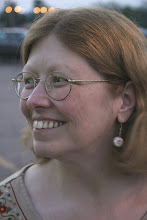
In case you’ve been wondering, I haven’t gone missing. I’ve been on the road, traveling with my favorite photographer, Kevin Scanlon (who also happens to be my husband). Kevin shows me the world in ways that I would otherwise miss. All I have to do is hang out with him and watch him work to see things in new ways. Believe me, it’s not just with anyone that I would venture out early enough to watch dawn break over the city on a cold morning. Writer Jack Kerouac, who was a friend of photographer Robert Frank (Kerouac wrote the introduction to Frank’s book The Americans), once said that a good lesson for any writer is to pay attention to how a photographer works and to look at what he shoots. I say, Amen.
There’s an excellent interview with Kevin at “Wedge of Smoke” by Chris Crook, which reveals insight to his creative process and the evolution of his subject matter. Click here to read the interview and see some of Kevin’s photographs.
The photographic exhibition “Andre Kertesz: On Reading” comes at a time when technology is changing the format of how text is published and how we read it. Currently on display at the Carnegie Museum of Art in Pittsburgh through February 13, 2011, each of the 100 photographs contains a visual story of readers immersed in a textual story. Linda Benedict-Jones, curator of photography at CMOA, describes the importance of Kertesz’s work in a short film clip available for viewing at the PBS website, where you can also view some of Kertesz’s photographs.
It’s interesting to me, in light of how technology is changing publishing and how we read, that Kertesz seemed to embrace the changing technology of photography with his early adoption of small format hand-held cameras such as the Leica. Late in life he also worked with the Polaroid SX-70 camera, and I suspect that he may have even appreciated and used digital cameras had he lived a few more decades to see their advent.
Andre Kertesz (1894-1985) was born in Hungary and came to the United States in 1936 where he lived in New York City until his death in 1985. Throughout his lifetime he returned again and again to the subject of people reading. These are ordinary people deeply engaged with the written word, escaping into the private word of reading in public spaces of cities in Europe, Asia, and the United States.
Walking through the Works On Paper Gallery at CMOA yesterday afternoon, I was transported by the gorgeous black-and-white prints to a time and place which seemed to move at a slower pace. Who were these people in the photographs? What were they reading? The images show people reading on terraces and fire escapes and rooftops, in city parks, on city streets and on public transportation, and in quiet moments at the shops or places where they work. One image, which also appeared on the cover of the first edition of the book On Reading published in 1971, shows a young woman reading backstage at a carnival, a coat loosely wrapped around her, but her shoes and top hat reveal that she is one of the performers.
These are people that remind me of me – trying to find a quiet place to escape into whatever book I am reading during my lunch break at work or while waiting for an appointment. Recently, when I was waiting while my car was being repaired and reading Franzen’s Freedom which I’d been lugging around with me, I watched an elderly woman settle herself into a chair and take a Kindle from her bag to read her e-book. She was every bit as involved with the text on her e-reader as the people in Kertesz’s images were with their paper-based text.
Having watched how digital technology changed photography in the past decade, I’m excited by the changes it is bringing to publishing. I will always enjoy traditional books and paper-based text, but I will also buy e-books (and I wouldn’t be surprised if I end up buying some books in both formats). In fact, I think e-books will truly expand and open up the publication of photography books, which until now have been extremely expensive to print in traditional book format. The iPad is a perfect format to make photography books more affordable for both the reader and the publisher. The iPad is also a great way for photographers to have a portable portfolio containing a large library of their work.
Currently I’m reading Caroline Leavitt’s new novel, Pictures of You, on my iPad and enjoying it immensely. Reading a book on an e-reader is different in some ways than reading a paper-based book, but I find myself drawn into the story in new ways, less aware of what page I’m on and truly involved in the text at the level of the sentence and paragraph. However, I’m not sure that it is our relationship to the text that is truly changing, but rather that our relationship to the text format is changing. I’m every bit as absorbed by the novel I’m reading on my iPad as the readers in Kertesz’s photographs are absorbed by what they are reading.
In 2008, Kertesz’s On Reading was reissued by Norton and includes 66 of the 100 images from the exhibition. It’s a beautiful book, and I’m very happy to have a copy in traditional book format, although the reproductions in even the finest book can never match the quality of the prints in an exhibition. This is a book I will take from the shelf and admire many times over the rest of my lifetime, but I expect that I will begin to buy photography books in e-format as they become available.
I hope you have the opportunity to see this traveling exhibition in Pittsburgh or at its next stop. A portfolio of Kertesz’s photographs is available for viewing online at the Stephen Bulger Gallery website. Henri Cartier-Bresson said, “Each time Andre Kertesz’s shutter clicks, I feel his heart beating.” Me too. And I suspect that you will as well.
[I’m honored to host a guest post this week by Slovenian photojournalist Misko Kranjec. I met Misko in the spring of 2007 when he traveled to the United States to give a presentation at the Center for Railroad Photography and Art’s annual conference. He spent several weeks touring the U.S. on that visit, including a few days photographing in Pittsburgh prior to traveling to the Chicago area for the conference. Misko is an award-winning photographer and the son of writer Misko Kranjec. ~ Dory]
Lens and Pen as Mirrors When Dory invited me to write a short reflection of how my father, a prominent Slovenian writer, and his writing influenced my photography, I thought it would be a piece of cake – a few sentences, blah, blah blah, and voila – done. This was not because I would undervalue Dory's blog and her endeavor in any way; I was just overestimating my capacity to analyze myself, and in English on top of that.
Actually, I never gave much thought about my own photographic aims – the concepts and inner meanings, or the mission of my work. I was just an observer of the world with the camera, recording what attracted my eyes and triggered my feelings. I didn't make a fuss of my efforts. For me, photography was always fun, and throughout the 30 years of my photojournalistic career, I always tried to keep it this way.
My father was a prominent writer in his time, kind of a Slovenian Faulkner, writing about Prekmurje – that northeastern region squeezed between Austria, Hungary, and the Mura River – and of the people living there. At the time of his birth in 1908, this region still belonged to the Hungarian part of the Austro-Hungarian Empire, but after the First World War it was associated to the new born Kingdom of Yugoslavia.
Totally rural and without any industry worth mention, this region was extremely poor. Half of it was either swamp or covered with thick forest, most of it belonging to the Hungarian Count Zichy family who had a castle in Beltinci and owned the biggest part of the arable land. What was left was far from being capable of sustaining the peasants living there, so the men either temporarily left their families to work as seasonal hired help in other parts of Yugoslavia or abroad, or whole families immigrated, mostly to the United States, Canada, or to the countries in South America.
After the WWII and with the birth of the Socialist Republic of Yugoslavia, the last of the Zichy Counts, the Countess Maria Zichy, fled to Austria. The land and the castle were confiscated and turned into a state farm. The swamps were mostly dried and turned into fields or grazing land and divided among the farmers. Significant progress came to this region and several factories were built, yet the region still remained predominantly rural, underdeveloped, and poor. What money came in was mostly from those working temporarily in Austria, Germany, and
France.
However poor they were, the people living in Prekmurje were extremely friendly and open, willing to invite even a stranger into their modest homes and share with him the last loaf of bread and the last bottle of home-grown wine. Those were the people and the land my father wrote about, and when I started with my photography back in the early 1970s, the scene there was pretty much the same as it had been decades earlier. While many new houses had been built, and cars and tractors started to emerge in ever greater numbers, there were still numerous clay-plastered wooden cottages with thatched roofs, carts and plows were still draw by cows, and the farmers, especially the women, still dressed as they did a century ago.
All this gave me a great opportunity to record on film at least a bit of what my father wrote about in his novels. True, the scene was changing rapidly and it took some careful framing to avoid the signs of modern times in order to record it as it had appeared in the past. Perhaps I could even be accused of deliberately twisting the truth, but in this case it was not the truth or the present Iwas aiming for, but rather the past – the world of my father which gave him so much inspiration and so many stories and human destinies to write about. Disappointed with my first attempts to write about this for Dory’s blog, I decided to steal from my father by translating from the beginning of his book Youth in the Swamp, one of his last novels which is actually a biography of his childhood. So I started to translate this part of his book, and became too excited with my doing it to stop. Some of my father's work has been translated in several languages, but none in English. In front of me was my father’s book about his youth in this poor land, and on the very first inner page, before the title, written in his handwriting was inscribed: To my son Misko, as the mirror to the long gone days. January 15th, 1963. I was sixteen at that time, and little did I know that one day I’d be holding a mirror of my own – the camera.
As a kid, I was often in Prekmurje. During the summer holidays my father would take me with him whenever he would go there to write in the house that he, my mother, and his brother had built before World War II, which replaced the thatched-roof cottage where he was born. Back then, I didn't even like Prekmurje very much. We would stay there for two or three weeks, and these were very long and boring weeks for me. I was a city boy, and at home I had friends that I would play with the whole day long, every day in summer. But in Prekmurje, I had no other friend but the son of the school master. All the others were peasant kids, who spoke a dialect I could hardly understand. While my father was writing, I was left to my own devices which meant mainly reading books, playing with my toys, and feeling lonely and bored. In fact, I hated Prekmurje then.
Years later, during my leave from army service, I happened to visit Prekmurje for a day, and there I met a lovely girl who would inspire about a hundred love letters, and later she became my wife. With that moment, my eyes viewed this land in a totally different light. We visited relatives there at several times a month, and her home became the base for my photographic explorations. Even though it was in the early 1970s, modern times had not yet really touched this remote land. The old people, the old cottages, and the old way of living – everything in fact that my father had written about in his books – was still very much present. I was just taking my first serious, formative steps into photography then, and my father's world suddenly became a great subject for my camera. It also became very, very close to my heart.
I may have thought I hated this land as a kid, but actually I was soaking its spirit into my blood. The love for it and for its people had been hidden within me, but as I photographed, those feelings and affection surfaced. The people of my father's books were suddenly there, in blood and flesh, standing in front of me, speaking to me, inviting me into their homes, offering me their wine and food. Just as the people had come to life, so had the words my father put onto the page – all with new meaning.
Looking through the viewfinder, I felt them in my mind and they spoke to me and guided my eye while I was framing, and even then I did not yet realize that I was holding a mirror to those long gone days too. Yes, they were still there, as though frozen in time, not really the past yet – but it was fast thawing and running out.
Today, I am happy I had the chance to record the last remains of this world. In less than a decade the scene changed completely - the lovely old cottages were replaced with the modern houses, big John Deeres replaced the cows, and the old people died, one by one. In the mid-1980s there was almost nothing left of the old Prekmurje to photograph, and what remained was mostly weed-grown ruins.
I don't know whether it was an omen, destiny, or just coincidence that my father died in that same time. Unfortunately with his death also started the process of the oblivion of his work, more or less triggered by events which followed the secession of Slovenia from Yugoslavia in 1991. This was a time when the regime here changed to the right, to the conservative side, which considers my father as a "red" writer, writing foremost about the poor and deprived but good-at-heart people, the peasants from his Prekmurje, and because he openly favored socialism. Not a single book of his has been reprinted since his death, and I can openly say he was deliberately pushed into this state of oblivion.
Well, actually not quite, as last year was the 100th anniversary of his birth and suddenly he was remembered again – for a brief moment. The Association of Slovenian Writers organized a literary evening, held in one small auditorium of the big cultural center in Ljubljana, where writers and poets from Prekmurje read their works in honor of my father. Five days before this event, one of them remembered that I had photographed Prekmurje extensively and thought it would be good to show my photos during the reading.
They asked if I would prepare a photo show. At first I refused, as this would mean scanning and retouching many photographs from negatives that I hadn’t held in my hands for at least 25 years. I calculated I would need between 300 and 400 images for a two hour event, to be shown on a screen during the reading. However, after more thought, I changed my mind. First, because of my father; I said to myself, I owe him this. And second, because of me; it had been a while since I’d had an exhibition of my photographs, and I told myself, it is always good to show people you are still around, important to defy oblivion.
The idea for this blog began with a certain synchronicity of life events last spring and began to jell as I read several novels which used photographs as story details and photographers as characters. One of those novels was Dani Shapiro’sBlack & White. Shapiro crafts a story about the relationship between a mother and her daughter – the mother, Ruth Dunne, a photographer whose fame is based on a series of photographs she’d done of her then prepubescent daughter, Clara. It’s a story about identity, where the boundaries between the roles of being a mother and an artist are blurred, and about the effects of those photographs on the daughter who struggles to maintain her own identity separate from her role as a model for her mother’s fine art photographs. The novel opens as Clara, now an adult living in Maine with her husband and their young teenage daughter, learns that her mother, who she has not seen in fourteen years, is gravely ill. Clara reluctantly goes back to her childhood home in New York City to see Ruth Dunne.
The narrative explores the function of memory in a very engaging way, the voice lending a current of authority just below the surface of the story. I’m fascinated by how photographs, particularly those frozen glances back through time which end up preserved between the pages of family photo albums, become incorporated into memory – when the facts of those images can be as unreliable as memory itself. For instance, do we remember the event or do we remember the photographs of the event that we grew up looking at in the family album? Those images begin to take on a history and story of their own. In Black & White, Shapiro writes: “Impossible to isolate a memory: to carve it out and separate it from what has come before or after, from what has been told and retold. Stories turn what we remember into a series of polished little gems.”
It was impossible for me to read Black & White without thinking of the photographs of real life photographer Sally Mann, who did a series of images of her three children in the 1980s. The photographs were exhibited and then published in 1992 as Immediate Family. Mann’s work was controversial and drew harsh criticism from those who believed she was exploiting her children. Her work made people uncomfortable, particularly the sexuality of the nudes.
I contacted Shapiro to ask her if the photographs in Mann’s Immediate Family had an influence on her in writing Black and White. She responded: “I was very much influenced, when thinking about the novel, by the work of Sally Mann and by my different responses to her work over the years, especially after I became a mother.”
This response intrigued me since my own reaction to Mann’s photographs is very mixed. The images are technically gorgeous, the subject matter often provocative, and her photographic eye bold. But many of the images of the children are disturbing: surreal yet earthy, feral, intimate, suggestive but not pornographic – although some of the images come uncomfortably close to that edge.
I asked Dani about what ways her own responses to Mann’s work changed and how being a mother affected the way she viewed Mann’s photographs. She responded: “I first encountered Sally Mann’s photographs when I was in my twenties. I was very taken with her work 'Immediate Family.' I found it evocative, provocative, quite stirring. In fact, I very much wanted to own a photograph of hers, but couldn’t afford one. The images stayed with me, and though I saw other work of Mann’s over the years, I found 'Immediate family' to be her strongest. Then I encountered the photographs again, in my late thirties, as the mother of a young child. And though the images had the same impact on me as they always had, there was an additional, somewhat uncomfortable layer to my response. I realized I was asking the question: how were these pictures taken? It occurred to me, as it never had before, that the photographs were posed, staged, lit. I wanted to know how it had happened. How the mother, Mann, had asked her children to pose. So I answered those questions the only way I could – by writing a novel and imagining those scenes myself.”
In Mann’s work, there seems to be an undertone of defiance not only in the subjects, but also in the photographer. In the later photographs of the “Immediate Family” series which was done over several years, the children are at the edge of innocence, at the edge of childhood, seeming to play at the role of pretending – pretending to play dress-up, playing at innocence. These are not spontaneous or candid shots, but are set up and posed in exactly the right light. The images were shot with a large format camera, an 8 x 10 view camera, which involves a slow and tedious shooting process that requires a lot of set-up time to arrange and compose the subject in the frame. This is the type of camera which must be set up on a tripod and where the photographer looks at the image in the ground glass on the back of the camera under a dark cloth. Because exposure times can be long, subjects must remain very still to hold a pose for the camera, which means the children were full participants in making the photographs.
Dani Shapiro had been a child model herself, and she has written about this experience in her own nonfiction books and in articles such as the essay “Frame by Frame” for Vogue (June 2007). I asked Dani if that had an effect on how she viewed Mann’s work. She answered: “I’m not sure that being a child model affected the way I viewed Mann’s work, because really my modeling career – such as it was – was incredibly tame. I was the baby in the Beechnut Baby Food commercials, which of course I don’t remember. When I was three, I was the little girl on the Kodak Christmas poster, and I do remember the feeling that it was somehow important. I had some awareness that my picture was being taken and it was a big deal. Honestly, I never once consciously thought of that time while I was writing Black & White, though that doesn’t mean it didn’t have an impact.”
In the introduction to Immediate Family, Sally Mann writes: “These are photographs of my children. . . Many of these pictures are intimate, some are fictions and some are fantastic, but most are ordinary things every mother has seen. I take pictures when they are bloodied or sick or angry. They dress up and posture, they paint their bodies, they dive like otters in the dark river.”
Hearing Mann talk about her photographs and seeing her at work, as shown in the documentary film “What Remains: The Life and Work of Sally Mann,” is more interesting to me than viewing the actual photographs. What she says about her work adds a layer of understanding that allows me to look at them in a different way. Watching the film, I finally understood that she uses her camera to find answers to her questions (particularly her later work which explores death), in the same way that writers use words and narrative to find answers by crafting stories around their questions.
In Black & White, Shapiro explores questions about the impact of an artist’s work on family members, creates fictional characters that are believable and behave in compelling ways, and describes photographic images that read as real. The novel’s epigraph, which also serves as a fitting close for this post, quotes photographer Walker Evans: “Stare. It is the way to educate your eye and more. Stare, pry, listen, eavesdrop. Die knowing something. You are not here long.”
"Arrange what pieces come your way." ~ Virginia Woolf
About This Blog:
In This Light is a blog about the influence of images on writers and writing. Think of it as a place where imagery joins narrative, to see how things look through the light of words.
I live and write in Pittsburgh, PA and have a diverse background with degrees in photography and psychology, as well as an MFA in writing from Vermont College. I prefer to think of this as the winding path toward writing -- a journey where interests in image and human behavior converged as story.
My work has appeared or is forthcoming in Connotation Press, Now & Then: The Appalachian Magazine, The Santa Fe Literary Review, The Avery Anthology, Hamilton Stone Review, Blue Earth Review, Hobart, Slipstream, Forge, Word Riot, The Oklahoma Review, Common Ground Magazine, Shalla Magazine, and Paper Street. My story "Tests and Measurements" which appeared in Workers Write! Tales from the Clinic was nominated for a Pushcart Prize in 2009.
 Kevin Scanlon Photographing at Dawn


 Posts
Posts