Sunday, October 25, 2009

Writing and Telling Stories: October in Wild & Wonderful West Virginia


Writers of fiction live multiple lives when they are working on a story – the reality of their own daily lives and the fictional lives of their characters. That dance in and out of fictional and real worlds can be a difficult balancing act, particularly if the writer is working on a novel. I seem to require large blocks of time to immerse myself into the world of the characters in the novel I’m writing, but it’s been difficult for me to find stretches of sustained time. I get up very early in the morning to write before going to my job, but I’ve found it easier to work on shorter pieces in these smaller bursts of writing time. My current goal is to figure out how to use these morning hours to finish my novel. I know it can be done; I just need to figure out how to manage it.

During fall vacations with my husband, which we’ve turned into creative retreats, I’ve made significant writing progress on my novel. A favorite October vacation spot is Babcock State Park in Clifftop, West Virginia, where there are thirteen secluded log cabins along Glade Creek. Built by the Civilian Conservation Corps during the Depression, the cabins have electricity, fully equipped kitchens, and bathrooms – but no heat except for the huge fireplaces. In a different area of the park there are modern cabins with heaters and air-conditioning, but they are spaced closer together and we prefer the privacy and setting of the older cabins near the stream.

It takes planning and smart packing for those trips. The cabins are spaced apart from each other along the ravine on both sides of the creek, surrounded by woods and separated by walls of wild rhododendron among huge boulders. Paths and wooden stairs lead down to each cabin from parking areas at the top of the hill, so carrying in a week’s food and gear can be quite a task – particularly if that includes camera equipment, laptop computers, books and notebooks.

Our favorite cabin used to be cabin #13, until the steep steps down to it became a deterrent for my aging knees and Kevin tired of lugging all that stuff (okay, it was mostly my stuff) down to the cabin by himself. That, and the fact that a murder had occurred in that particular cabin. I was appalled to learn that someone had committed such a violent act in what had once been a special spot for us – in such a serene and beautiful place. From that time forward a different cabin became our favorite, for its high ceiling and sleeping loft, not to mention it had only half the number of wooden steps down to it, nor had it been a crime scene.

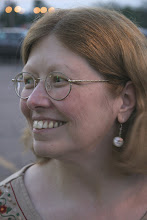
Babcock was a good and productive spot for us creatively. Kevin would spend his days out photographing and I would spend my days at the cabin immersed in my writing. He’d leave before dawn and come back after dusk, when we’d have dinner in front of the fire and discuss the progress on our projects. The photograph of me at the top of this post is one Kevin took (unbeknownst to me at the time) through the cabin window as he was leaving in the darkness early one morning -- I was sifting through research and settling down to write, still wearing my nightgown and drinking my breakfast coffee.

During one October visit it was particularly rainy, which didn’t bother me because I was cozy in front of the fire all day, fueled by hot coffee, typing away and exploring the fictional world of my main character who is having an emotional breakdown following the Loma Prieta quake – she has fled San Francisco for the New River Gorge area of West Virginia which was her childhood home. The rain was a bigger problem, however, for Kevin, who nonetheless trudged off in the pre-dawn hours every morning, hopeful that the weather and light would change for the better.

There’s a stepping off that happens in the writing process, a letting go that requires me to feel I’m in a safe place, particularly with this novel, given the fragile state of the main character who is in crisis as her world is literally crumbling around her those last weeks of October 1989 following the Loma Prieta quake. I need to be on solid territory when I enter her world. It’s not the kind of book I could write while sitting in a public space such as a coffee shop. But in the cabin, I could enter her world safely for an entire day without interruption and then transition back to the real world when the dimming daylight signaled it was time to wrap things up until the next morning. Then I’d turn on the radio and listen to NPR to ground myself with the day’s news while I cleaned up my writing space in the main room of the cabin, clearing the big wooden table I’d used as my writing desk so we could set it for dinner. Kevin would return and we’d cook our meal, open a bottle of wine, and talk about our day. It was invigorating to share our progress, to spur each other on in our creative pursuits.

Toward the end of that week, on yet another rainy day, Kevin came back to the cabin a little earlier than I’d expected. I was still writing and hadn’t transitioned out of that fictional world yet. He was acting very nervous as he set down his camera bag. I sensed that something was wrong and wondered if he’d been in an accident. He put the red tote bag he used for extra film and camera accessories on the table. Then he told me about the flying saucer he’d seen crash into the New River at Sandstone Falls. I didn’t know what to say as I tried to figure out whether he was joking or had gone off the deep end. He seemed serious. While thoughts raced through my head (such as, There probably isn’t a ranger at the headquarters building since it’s after 5:00 – how am I going to get help to take him to a hospital?), he said, “You’re looking at me like you don’t believe me.”

Now, you need to know that Kevin is the steadiest and most resilient person I’ve ever known. He can also make me laugh like no one else and always knows how to lighten things up with his humor. But, he seemed dead serious about seeing a UFO. As I tried to assess the situation, I asked him to tell me more. So he did. He proceeded to tell me a tale filled with every bad sci-fi movie cliché there is, about how he was sitting in his truck at Sandstone Falls waiting out a rainstorm and hoping to get a shot of the falls when he saw the UFO crash. Somehow those clichés served to make the story even more frightening for me. It was pretty much the same story all those nut cases tell that used to make the headlines, and he was beginning to remind me a little bit of Richard Dreyfus in Close Encounters of the Third Kind. More thoughts raced through my head. (Really? It’s true that there really are UFOs?)

Then he told me about the alien. (OK buddy boy, this just isn’t fair to come in here before I’ve transitioned out of writing mode and tell me about witnessing some UFO crash. Now there’s an alien to deal with, too?) The alien had ejected from the crashing spacecraft, and while he was dying of injuries on the bank of the New River in the rain, he’d begged Kevin to save him by cutting out his brain so that his fellow aliens could retrieve it and rescue him. If they could take back his brain, they could restore him to life.

“Ummm, so what did you do?” I asked. He told me he’d cut out the brain, and that he’d promised to leave it on the porch of our cabin so that the dead alien’s friends could come get it that night. (Should I try to escape from the cabin and call the ranger from that phone booth in the parking lot up at the park headquarters? Unless . . . really? You mean there really are little green men from other galaxies? That’s not just made up? It’s for real?)

I was still trying to regain my equilibrium . . . but Kevin was making that difficult. My fight-or-flight adrenaline rush was not helping matters. I’d had a double dose of that adrenaline response, first to deal with a husband who’d lost his grip on the real world, and a second one to grapple with the aspect of aliens visiting our cabin around midnight to retrieve the brain of their dead little green friend.

Finally, I asked him where the brain was, and he told me he had it right there with him in his red tote bag, which he unzipped and reached into with hands shaking almost as much as my adrenaline-filled body. Then he pulled out a big green Osage orange. If I hadn’t been so relieved there may have been another Babcock cabin homicide. Those hunks of firewood make handy murder weapons to use in bludgeoning a spouse to death.

With the big Osage orange reveal, I was fully back in the real world. Mad, but wholly in reality. I had to forgive him – he’d been having such a lousy photography week. I’m sure he expected me to be amused and never dreamed I’d actually be frightened, even if we were in a remote cabin so close to Halloween. And I might have been entertained by his tale, had I not still been in the alternative universe of my own writing life. Until then, he had no idea what it was taking for me to truly enter into the dark world of my novel filled with earthquakes and disappearances and lost girls on the run.

We opened some wine. I made him pose for a picture holding his alien Osage orange brain. We turned on the radio and listened to NPR while we cooked dinner. We warmed ourselves by the fire after dinner and finished the wine. And that night before we went to bed, Kevin put the alien brain out on the porch, where it remained for the last few days of our vacation. And on each of those remaining mornings, I was just a tiny bit afraid that when I opened the cabin door I would discover it was missing.


Photo Credits:

Top Photo: Dory writing at dawn in cabin, copyright by Kevin Scanlon, used by permission

Bottom Photo: Kevin with Osage orange alien brain, copyright by Dory Adams

Sunday, October 18, 2009

Graveside: Jack Kerouac, "The Railroad Earth"


October 21st will mark the 40th anniversary of Jack Kerouac’s death. He’s one of those writers of an era, whose work stays with me over the decades. I’ve revisited his books many times since first reading On the Road in 1977. Jack Kerouac died on October 21, 1969 at the age of 47, and in May of 1983 I went to Lowell, Massachusetts to find his grave.

I’d traveled by train from Chicago to Boston to visit friends. Amtrak was having some sort of special fare. I don’t remember the details of the deal except that it allowed me to make several stopovers along the route so that I could also visit friends in Buffalo for a few days. It was a good enough bargain that I was able to afford a sleeper car roomette, a welcome luxury since most of the trip between Chicago and Buffalo was at night.

Cozy in my roomette, I watched out the window until dusk turned to darkness, amazed at how different the towns looked from my vantage point aboard the train – inside the lowered crossing gates with bells clanging and lights flashing where the tracks crossed streets and roadways. I had a new paperback with me, Joan Didion’s The White Album, and after it got too dark to enjoy the scenery I lost myself in those pages – reading about the power of water in her essays “Holy Water” and “At the Dam” while my train rolled along dark rails at the southern edge of Lake Erie. The tracks ran closer to the lake at industrial areas, where mills still operated at nearly full blast, although the Manufacturing Belt was already corroding into what would become the Rust Belt. Despite my cozy nest in the roomette, I don’t think I slept much that night. I was homesick for California, and reading Didion’s essays for the first time. She had me hooked from the very first sentence of the first essay: “We tell ourselves stories in order to live.” She was writing about the end of an era, the end of the 1960s. It was the beginning of the 1980s then, and I was somehow saying goodbye to the 1970s on this journey as I headed further east, saying goodbye to California even though I’d left it behind the year before with the move to Chicago.

In Boston, I visited longtime friends Sherry and Jeff, who’d also lived in California for a few years after we’d all graduated from art school in Pittsburgh half a decade earlier. I’d been having a difficult time adjusting to the flatness of the Illinois landscape and needed a change of scenery. Needed to travel for a while. Needed hills and mountains. Needed to be near water that moved with oceanic tides. Chicago and Lake Michigan made me feel oddly claustrophobic, and I needed to escape the prairie land of the far southern suburbs where we lived.

Sherry and Jeff wanted to show me as much of New England as we could squeeze into a weekend drive, and we managed to see parts of New Hampshire and Maine. I saw the Atlantic Ocean for the first time on that trip. It’s ironic that I would see the Pacific Ocean first, after having grown up living much closer to the Atlantic. Looking at maps during our drive back to Boston, I spotted Lowell and requested that we go there to see the town where Jack Kerouac had grown up as a boy. It was where he was buried, and I wanted to try to find his grave.

Lowell looked exactly as I’d expected it to look, with brick mills along the Merrimac River. Despite there being many cemeteries in Lowell, Jeff instinctively turned the car into the correct one. We found a caretaker who asked, “Who yer lookin’ fer?” When I said Kerouac’s name, he went inside his gardener’s shed and brought out a mimeographed sheet of paper with directions to Kerouac’s tombstone. It pleased me that enough fans came seeking his gravesite that they’d printed directions.

There may be a different marker there now, but the small flat stone in the photograph above marked his grave then. We stayed only a few minutes. I no doubt would’ve lingered longer had I been alone. But, it was getting late in the day and we still had to drive back to Boston. It was just one stop on our journey, a side trip really, before getting back on the road again.

Leaving Boston by train, I thought about Kerouac. I’d read most of Kerouac’s work while living in California. One of my favorite pieces was “The Railroad Earth” in Lonesome Traveler, about working as a brakeman for the Southern Pacific Railroad while he lived in San Francisco. In the essay, Kerouac reminisces about Lowell while he’s working in the rail yards and riding the trains between San Francisco and San Jose. There’s something about traveling that makes us think about other places we’ve been and about the people we were with there. I was missing my husband whose job had kept him in Chicago while I was on this trip. In New York City I would change trains and then travel west to Pittsburgh for another stopover before returning to Chicago – toward what was our home for a brief while.

When I was younger I mostly measured time by weeks and months; only long chunks of time such as school grades and birthdays were measured in years. Now, I measure time in decades. I was barely out of my first decade when Kerouac died. As we quickly approach the end of our first decade in the 21st century, I’m already in my fifth decade, having surpassed the length of Kerouac’s short life. Rest in peace, Ti Jean. Your words live on as I continue speeding through my own lifetime.

News and Updates:

• Photojournalist Clyde Hare died last week. Hare came to Pittsburgh to work with Roy Stryker on the Pittsburgh Photographic Library Project and then made Pittsburgh his home for the next fifty years. The Pittsburgh Post-Gazette news obituary includes several of his images of Pittsburgh in the 1950s. Hare’s photographs are included in the collections of the Carnegie Museum of Art and at George Eastman House, among others.

• Congratulations to Jayne Anne Phillips whose latest novel Lark & Termite is a finalist for the National Book Award.

• Carnegie Mellon University Press has announced the release of a new edition of Chuck Kinder’s The Honeymooners: A Cautionary Tale as part of their Classic Contemporaries list. The new edition includes additional chapters and lost love letters which were not included in the original edition, as well as an introduction by Jay McInerney. Even though I have a signed first edition on my bookshelves, you can bet I’ll be buying and reading the new edition as soon as I can get my hands on it.

Photo Credit:
Jack Kerouac’s gravestone, copyright © 1983 by Dory Adams.

Sunday, October 11, 2009

Abandoned and Reclaimed Things: Railroad Architecture

Michigan Central Terminal Main Entrance (photo copyright 2009 by Keith Burgess)

(Click on images for larger view)

Much has been written lately about the fate of Detroit’s Michigan Central Terminal, which was recently slated for demolition. Photographers drawn to the Beaux Arts style building in order to document its ruin have managed to capture traces of its lost grandeur. Why do we allow our history to crumble? What has influenced us to think of our buildings as disposable? Instead of restoring and re-purposing our architectural gems, we bulldoze and replace them with structures that can never compete with the beauty, craftsmanship, building material quality or architectural detail of the originals. We are losing our heritage and along with it our sense of place.

Interestingly, there has been some recent backlash about photographers misrepresenting Detroit and producing a biased perspective called “ruin porn.” The complaint is that photographers are framing shots in such a way that they omit well-maintained occupied buildings just beyond what is included in the frame. Thomas Morton makes the point that the buildings being shown over and over in the media are structures that have been vacant and in decline for decades, such as the Michigan Central Terminal (vacant since the 1980s) and the Packard Motor Car Plant which closed in the 1950s.

What is included within the frame depends on the story being told. Photographers tell their stories by using the viewfinder to frame and capture images; writers place a similar frame around their stories by choosing what to tell and what to leave out. Editors then sometimes reframe those stories and photographs by making deeper cuts. I would argue that the point of those Detroit urban decay photographs is that the ruined structures stand as omens, as prophecies of what may await other once-magnificent corporations unless they adapt with the times. We don’t like to be shown our mistakes and missed opportunities. There was a certain window of time when those buildings were still salvageable, but instead they were allowed to slowly slide into ruin over the decades.

Detroit’s Michigan Central Terminal is beyond saving. However, there are other historic buildings that could be saved, such as Buffalo’s Central Terminal. Since I first saw this building a few years ago, I have not been able to forget it. It was love at first sight. Standing on the front plaza drive and looking skyward to the clock tower, I was smitten by the Art Deco styling and details. It wasn’t hard to imagine the upper floors of the tower turned into condominiums, office space below, and shops and businesses located in the main terminal.

The Central Terminal Restoration Corporation (CTRC), a 501(c) (3) nonprofit organization is working to restore and preserve the terminal. The first goal of the CTRC is to stabilize and seal the building from the elements. Many of the Buffalo Central Terminal’s interior details, such as light fixtures, ornamental detailing, and railings, were removed and sold by previous owners. Art Deco lamp fixtures ended up in a Hong Kong restaurant where they still remain, but the clock was bought and returned to the terminal after it turned up for sale in Chicago on eBay. The Buffalo Central Terminal property is owned by several entities. The CTRC “owns the main concourse building and baggage building. The now detached train concourse is currently owned by Amtrak. The mail building is currently owned by the City of Buffalo.” It’s estimated that it would take approximately 56 million dollars to complete the restoration.

Buffalo Central Terminal (copyright 2009 by Kevin Scanlon)

Whether it’s feasible to save a particular building and whether it’s possible to save the building are two different questions. Pittsburgh has managed to save two of its railroad terminals by renovating them for new purposes. The Pennsylvania Railroad’s Union Station, later renamed Penn Station, in downtown Pittsburgh was transformed into The Pennsylvanian, a 13-story mixed-use building housing apartments and office/retail space. The apartments are located above what was once the main terminal, the concourse is now leased out for special events, and the rotunda has been deemed an historic landmark and is part of the National Register of Historic Places. The Amtrak station is still at that location, but is now housed underneath the old main terminal.

Pittsburgh’s Station Square is a complex of several buildings once belonging to the Pennsylvania & Lake Erie (P&LE) Railroad, including the freight house and the Landmarks Building which housed the Pittsburgh Terminal Train Station. The complex now includes a hotel, offices, shops, restaurants and night clubs, and the terminal is now home to the elegant Grand Concourse Restaurant.

Roanoke, Virginia is another city which has successfull
y renovated its historic railroad buildings for contemporary use. The Hotel Roanoke, originally built as a railroad hotel for Norfolk and Western Railroad travelers, has been renovated and expanded to include a conference center. Across the street is The O. Winston Link Museum, located in the former Norfolk and Western Passenger Station. Within easy walking distance is the City Market District, with restaurants, clubs, galleries, shops, and an open-air market.

Whether Buffalo will be able to rewrite the story of the Buffalo Central Terminal to include a happy ending is yet to be seen. If I could put my own story frame around that terminal, it might include a convention cent
er with hotels and restaurants. Or, the frame might hold condos above shops, offices, and restaurants. The efforts of the CTRC make that a hopeful possibility.

Buffalo Central Terminal Marquee Detail (photo copyright 2009 by Kevin Scanlon)


Photo credits:

“Michigan Central Terminal Main Entrance” copyright © 2009 Keith Burgess, used by permission


“Buffalo Central Terminal” copyright © 2009 by Kevin Scanlon, used by permission

“Buffalo Central Marquee Detail” copyright © 2009 by Kevin Scanlon, used by permission

Keith Burgess is a self-taught photographer who has twice won The Center for Railroad Photography and Art’s Creative Photography Gold Award (2007, 2009), and whose work has been exhibited at the California State Railroad Museum in Sacramento, CA. Burgess strives to reveal the underlying emotion of what he describes as otherwise “everyday mundane objects.” The images in his series “Portrait of the American Landscape” and “Architecture of Decline” convey solitude, sadness, loss, and longing.


Kevin Scanlon was born in Pittsburgh and has spent the past thirty-five years documenting heavy industry and railroads across the country. His photographs have been exhibited at art museums and galleries, and have appeared in various railroad-themed books and magazines, and on the covers of literary magazines and trade journals. He is currently working on a series of industrial landscapes in the Pittsburgh area.

Sunday, October 4, 2009

Appalachian Images: Fallout At The Greenbrier Hotel

The Greenbrier set isn’t exactly my crowd, if you know what I mean, yet I visited the Greenbrier Hotel twice last year. The first visit was to tour the underground bunker, built during the Eisenhower administration as a government relocation center for members of Congress in the event of a Cold War nuclear emergency. The second visit was simply to get another look at the hotel’s décor, particularly of the lobby bar for details I wanted to use in writing a short story.

The Greenbrier website describes the interior decoration as “décor unlike any in America.” I’ll say. All those bold Dorothy Draper and Carleton Varney designs stopped me in my tracks several times as I strolled through the hotel with my husband after we’d completed the bunker tour on that first visit. Occasionally I still have nightmares. Flashbacks. Not about the bunker, but rather about the décor. Those pinks and greens and large floral patterns provoke anxiety. And the green-swirl-patterned carpet of the lobby bar nearly dropped me to my knees with vertigo.

On that first visit we hadn’t taken our cameras inside the hotel with us, knowing we would not be permitted to take them on the bunker tour. The tour began at the West Tunnel, which was an entrance for vehicles behind a 25-ton blast door, and ended inside the hotel in the Exhibit Hall Foyer in the hotel’s West Virginia Wing where there was an interior portal. The bunker had been hidden in plain sight for more than thirty years, with part of it used as an exhibition hall (the 18-ton interior blast door was open and hidden behind a false partition), the hotel guests unaware they were walking into and out of the bunker area. The bunker housed a power plant, decontamination showers, a communications center which included a television studio, dormitories with rows of bunk beds, a clinic and dispensary complete with operating room and dental area, an incinerator (which could be also be used for cremation purposes), security and surveillance facility, cafeteria and kitchen, meeting rooms and an auditorium for the House of Representatives and Senate.

The existence of the bunker was made public in an article by Ted Gup of the Washington Post in 1992 when the facility had become obsolete. In fact, Gup makes a point that the usefulness of the bunker was always questionable. He writes, “Just how Congress was expected to reach the Greenbrier is unclear,” given that travel time from Washington, D.C. would have involved an hour by air or five hours by ground transportation, and would’ve been further complicated since the existence of the facility had been kept secret from all but a few key members of congress and “it would take far longer than that to round them up.” An even bigger question was whether Congressional members would actually go there since arrangements did not include spouses or family. How many members of Congress would actually be willing to leave their families behind?

Gup writes that at least once, “during the Cuban missile crisis – the Greenbrier facility was put on high alert.” I was in grade school during the Cuban missile crisis, but I remember well the anxiety of that era (including seeing homes being built with bomb shelters in the basements) and still carry that fear deep within me, as I’m sure most people of my generation do. We grew up with the threat of The Bomb, practicing duck-and-cover drills at our school desks and learning to be aware of which public buildings displayed Civil Defense Fallout Center signs. Somehow touring the bunker and seeing the absurdity and futility of that plan eased my old fears with the realization that there is no real plan – at least not for us regular folks. I was never destined to be part of the Greenbrier set, above or below ground.

However, one visit to the Greenbrier wasn’t enough. I had to go back – for research, for that short story. This time we took our cameras. We strolled around the grounds, which truly are gorgeous, particularly in autumn which was the season for our second trip. The outdoor infinity pool with the mountains in the background is stunning. The exterior of the hotel itself has always looked a tad institutional to me, though – and, in fact, it had been used as an army rehabilitation hospital during World War II. Inside the hotel, we splurged on lunch at Draper’s Café, where I had the best (and most expensive) fried green tomato sandwich I’ve ever tasted. Then we went in search of the lobby bar, to see if I could walk across that green swirl-patterned carpet without succumbing to vertigo. We walked through the upper lobby, which the Greenbrier brochures describe as “the Greenbrier’s living room . . . a series of lobbies and sitting rooms.” We got lost, wandering down hallways and rooms that opened onto other rooms. We photographed. I took notes. And we found the bar.


So, the story has been simmering for a while. I couldn’t get that carpet pattern out of my head, and couldn’t stop imagining what it might be like to try to walk across it after having a few drinks. I could envision someone having to crawl out of that bar on all fours. I’m a bit superstitious about saying too much before a story’s finished. Since there’s always a risk in talking too much about work in progress – of the story losing its energy before the work is completed – let’s just leave it that the details are in place. The characters are in the bar. The green carpet is swirling. And a photographer has just walked into that bar and started an argument between those characters.

Photo Credits:
Photographs of the Greenbrier Hotel copyright © 2008 by Kevin Scanlon, used by permission.

Sunday, September 27, 2009

Abandoned Things: Fleishhacker Pool

It’s suddenly fall. I’m not sure why this surprises me so much. Perhaps because summer never truly seemed to arrive, unseasonably cool and moving at a different rhythm and pace this year. Swimming pools have been closed up and readied for winter nearly a month now, at least in the parts of the country that have true seasons.

Summers seem shorter and shorter, and I long for one of those long, slow summers of my youth – the ones where I used to complain about being bored and begged my parents to take us somewhere we could go swimming for an afternoon. I rarely succeeded in finding my way to a pool, but I did manage to spend hours upon hours on summer days immersed in books, experiencing worlds beyond mine through the written word. I lived far from the privileged suburban lifestyle of the characters in John Cheever’s stories, where it seemed every backyard had a pool and cocktails were served promptly on the patio at the end of the work day, yet his story “The Swimmer” was a favorite. On those rare occasions when I got to go swimming, it was usually at a state park or at a community pool in the town where my cousins lived. One summer I was lucky enough to swim at the local country club for a few days while I was the houseguest of a friend who was a member. It gave me just a glimpse of how some of my classmates got to while away their summers.

In 1980 while living in San Francisco, I saw the biggest swimming pool I could’ve ever imagined when my husband and I wandered onto the grounds of the abandoned Fleishhacker pool. I don’t remember exactly how we ended up there, but I do vaguely remember that we had followed a path overgrown with shrubbery. What was this place? What happened to it? Knowing nothing then about the pool’s existence or history, we were completely amazed by its size and were a bit puzzled by its location since it was directly across the Great Highway from the ocean. The pool property was also adjacent to the zoo on its opposite side, which was the side we had approached it from, so it’s possible we had discovered the path to it on our way out of the zoo. It was like finding a secret.


The act of discovery is my favorite part of the writing process. It’s in those moments of clarity, of seeing how all the seemingly disconnected fragments of a developing story actually fit together with finding the missing piece, that the writing is truly joyful. Aha. So THIS is it. Of course! Why couldn’t I see it before? Sometimes the missing piece is an object. Sometimes it’s something a character says in a key piece of dialogue. I know I am not alone in this experience of typing away at the keyboard, or moving the pen across paper, to see what was hiding there all along just below the surface suddenly emerge.

Occasionally writers find themselves working at stories that just seem to go nowhere. We’re moving the characters around but nothing much is really happening. We try putting them in places and situations where that will change. And still, nothing happens. We’re stuck. There is no discovery. If we’re wise we put those stories away for a while and work on a different story. Sometimes these story fragments are forgotten and abandoned. Other times the characters nag at us until we pull the old draft out of the file drawer and give it another try, a fresh start after a break, or after a sudden insight that seems to come out of nowhere – usually when we are away from our desk, away from our computer, away from pen and paper. We find a new path, a different way into the story. We see a gate we hadn’t noticed before – and sometimes that gate is not only unlocked, it is standing wide open.

For me, the idea for a story often starts as an image. And where that image comes from, I have no idea. It’s just suddenly there, in front of me – whether it’s as a real object I’m actually looking at, or as an idea or scene I’m daydreaming about. It’s the same with stories I’ve put away thinking I’m done with them and that they’ll never be finished. I’m not sure why writing is such a visual process for me. I suspect that for some writers it’s more auditory – certainly it must be so for poets.

I wonder at what moment John Cheever realized his character Neddy Merrill in “The Swimmer” was going to swim across his suburban neighborhood, from backyard pool to backyard pool. What would Neddy Merrill have thought had he come upon a pool the size of Fleishhacker pool?

I like to imagine what it must’ve been like to swim at Fleishhacker pool, in a man-made pool filled with seawater that was so huge it was patrolled by lifeguards in small rowboats. Surely there is at least one story there. I’d often wondered over the years what had happened to the Fleishhacker pool site. Expecting to find that a condo had been built on that valuable property so close to the ocean, I was surprised to learn that the pool had been filled in and paved over for the purpose of additional parking for the zoo and that despite being condemned, the bathhouse still stands.


Photo credits: All photographs of Fleishhacker pool are copyrighted by Kevin Scanlon, used by permission.

Sunday, September 20, 2009

Dani Shapiro: Black & White


The idea for this blog began with a certain synchronicity of life events last spring and began to jell as I read several novels which used photographs as story details and photographers as characters. One of those novels was Dani Shapiro’s Black & White. Shapiro crafts a story about the relationship between a mother and her daughter – the mother, Ruth Dunne, a photographer whose fame is based on a series of photographs she’d done of her then prepubescent daughter, Clara. It’s a story about identity, where the boundaries between the roles of being a mother and an artist are blurred, and about the effects of those photographs on the daughter who struggles to maintain her own identity separate from her role as a model for her mother’s fine art photographs. The novel opens as Clara, now an adult living in Maine with her husband and their young teenage daughter, learns that her mother, who she has not seen in fourteen years, is gravely ill. Clara reluctantly goes back to her childhood home in New York City to see Ruth Dunne.

The narrative explores the function of memory in a very engaging way, the voice lending a current of authority just below the surface of the story. I’m fascinated by how photographs, particularly those frozen glances back through time which end up preserved between the pages of family photo albums, become incorporated into memory – when the facts of those images can be as unreliable as memory itself. For instance, do we remember the event or do we remember the photographs of the event that we grew up looking at in the family album? Those images begin to take on a history and story of their own. In Black & White, Shapiro writes: “Impossible to isolate a memory: to carve it out and separate it from what has come before or after, from what has been told and retold. Stories turn what we remember into a series of polished little gems.”

It was impossible for me to read Black & White without thinking of the photographs of real life photographer Sally Mann, who did a series of images of her three children in the 1980s. The photographs were exhibited and then published in 1992 as Immediate Family. Mann’s work was controversial and drew harsh criticism from those who believed she was exploiting her children. Her work made people uncomfortable, particularly the sexuality of the nudes.

I contacted Shapiro to ask her if the photographs in Mann’s Immediate Family had an influence on her in writing Black and White. She responded: “I was very much influenced, when thinking about the novel, by the work of Sally Mann and by my different responses to her work over the years, especially after I became a mother.”

This response intrigued me since my own reaction to Mann’s photographs is very mixed. The images are technically gorgeous, the subject matter often provocative, and her photographic eye bold. But many of the images of the children are disturbing: surreal yet earthy, feral, intimate, suggestive but not pornographic – although some of the images come uncomfortably close to that edge.

I asked Dani about what ways her own responses to Mann’s work changed and how being a mother affected the way she viewed Mann’s photographs. She responded: “I first encountered Sally Mann’s photographs when I was in my twenties. I was very taken with her work 'Immediate Family.' I found it evocative, provocative, quite stirring. In fact, I very much wanted to own a photograph of hers, but couldn’t afford one. The images stayed with me, and though I saw other work of Mann’s over the years, I found 'Immediate family' to be her strongest. Then I encountered the photographs again, in my late thirties, as the mother of a young child. And though the images had the same impact on me as they always had, there was an additional, somewhat uncomfortable layer to my response. I realized I was asking the question: how were these pictures taken? It occurred to me, as it never had before, that the photographs were posed, staged, lit. I wanted to know how it had happened. How the mother, Mann, had asked her children to pose. So I answered those questions the only way I could – by writing a novel and imagining those scenes myself.”

In Mann’s work, there seems to be an undertone of defiance not only in the subjects, but also in the photographer. In the later photographs of the “Immediate Family” series which was done over several years, the children are at the edge of innocence, at the edge of childhood, seeming to play at the role of pretending – pretending to play dress-up, playing at innocence. These are not spontaneous or candid shots, but are set up and posed in exactly the right light. The images were shot with a large format camera, an 8 x 10 view camera, which involves a slow and tedious shooting process that requires a lot of set-up time to arrange and compose the subject in the frame. This is the type of camera which must be set up on a tripod and where the photographer looks at the image in the ground glass on the back of the camera under a dark cloth. Because exposure times can be long, subjects must remain very still to hold a pose for the camera, which means the children were full participants in making the photographs.

Dani Shapiro had been a child model herself, and she has written about this experience in her own nonfiction books and in articles such as the essay “Frame by Frame” for Vogue (June 2007). I asked Dani if that had an effect on how she viewed Mann’s work. She answered: “I’m not sure that being a child model affected the way I viewed Mann’s work, because really my modeling career – such as it was – was incredibly tame. I was the baby in the Beechnut Baby Food commercials, which of course I don’t remember. When I was three, I was the little girl on the Kodak Christmas poster, and I do remember the feeling that it was somehow important. I had some awareness that my picture was being taken and it was a big deal. Honestly, I never once consciously thought of that time while I was writing Black & White, though that doesn’t mean it didn’t have an impact.”

In the introduction to Immediate Family, Sally Mann writes: “These are photographs of my children. . . Many of these pictures are intimate, some are fictions and some are fantastic, but most are ordinary things every mother has seen. I take pictures when they are bloodied or sick or angry. They dress up and posture, they paint their bodies, they dive like otters in the dark river.”

Hearing Mann talk about her photographs and seeing her at work, as shown in the documentary film “What Remains: The Life and Work of Sally Mann,” is more interesting to me than viewing the actual photographs. What she says about her work adds a layer of understanding that allows me to look at them in a different way. Watching the film, I finally understood that she uses her camera to find answers to her questions (particularly her later work which explores death), in the same way that writers use words and narrative to find answers by crafting stories around their questions.

In Black & White, Shapiro explores questions about the impact of an artist’s work on family members, creates fictional characters that are believable and behave in compelling ways, and describes photographic images that read as real. The novel’s epigraph, which also serves as a fitting close for this post, quotes photographer Walker Evans: “Stare. It is the way to educate your eye and more. Stare, pry, listen, eavesdrop. Die knowing something. You are not here long.”

Sunday, September 13, 2009

Appalachian Images: Guest Post by Photographer Kevin Scanlon


[The story behind a photograph sometimes changes the way we perceive that image. Guest photographer Kevin Scanlon shares the story behind one of his photographs – a story that reveals radiance that might otherwise be overlooked.]


My fantasy as a photographer is to have someone look at one of my prints on a gallery wall, put the back of their hand to their forehead and exclaim, “YES, that’s it EXACTLY! This photograph is very beautiful AND tells a great story!”

Never happens.

I hold up a frame to enclose a small slice of the world. Choosing what goes in that frame is the story I tell. My hope is to include enough to make the story clear, but sometimes a photograph needs to be married to words to be complete. My photograph of James and Cissy is an example.


* * *

“Would you mind if we keep these?”

I was startled. Not by the question, but by the presence of other people. I had just driven an hour on a dirt road to a tiny isolated town and then several miles further on a rutted mud path along Laurel Creek. When I parked next to the train tracks I hadn’t seen another car since town and there were no buildings of any kind nearby. The tracks were perched on a narrow ledge about 20 feet above the creek. I was picking my way between the rails, watching my steps. The voice made me look up suddenly. As a photographer I try to notice little things but I hadn’t noticed a man and woman, smiling broadly and walking toward me carrying two steel railroad tie plates each.

“I think the railroad couldn’t really care less,” I answered. The man must have thought I worked for the railroad. “Watch out,” I said, “there is a train coming up behind me in a few minutes.” I knew the train was on its way and I was hurrying to find a spot along the creek to photograph it. The couple watched me climb down the bank to the water and gingerly crawl out onto a large rock. The man was yelling something down to me but I couldn’t make everything out, something about a waterfall. They walked back and joined me along the creek, telling me about a large waterfall down the track about a half-mile.

“Maybe I’ll take a look at it after I get my photo of this train,” I said.

“Okay, we’ll wait and show you where it is,” he said. They seemed eager to take me there. Why not? My sun was almost down and I had nothing else planned for the day.

“Alright, that would be nice.”

The train came; the woman asked the man to step away so that they wouldn’t get into my photo. They bounced up the slope to the tracks after the last coal hopper had passed. I labored up behind them, grabbing at branches and twigs to keep my balance. We all walked down the tracks past my truck.

“You can drive down there if you want,” he said.

“I think I’d rather walk.”

“We love walking. We do this every day, up and down the tracks,” he said.

He told me their story as we walked. They had gone for a stay in a fishing cabin in February. He had fallen in love with her and had proposed marriage when they first got there. They had been in the cabin for almost seven weeks now.

“In the first week it got down to minus 2 degrees at night,” he said. “We knew it was cold but didn’t know how cold until we found a thermometer on the porch. We didn’t have a saw so we had to go out and find branches I could bust with my foot for the stove. It sure was cold but we kept bundled up.”

He told me all about their stay in the cabin. About the other people who spent weekends in the other fishing cabins. About the 12-inch brown trout he had caught in Laurel Creek. We talked about water quality, coal mining, the Sago disaster and mine safety. They told me about a sycamore tree 27 feet around up in Webster Springs, and another spruce tree over 20 feet around near Bergoo, dead with a new spruce growing up out of the rotted stump. We talked about dandelion wine and ramps. We talked about other places he had done extended camping and we talked about the wedding. “We’re getting married in about three weeks right up at the cabin,” he said.

All along the walk they were picking up railroad spikes and bits of metal. “Kind of like picking ginseng, you have to leave a little for next time,” he said. I didn’t ask, but I’m guessing they were selling it for scrap. Clean steel scrap was selling for about $5 per 100 pounds. As we approached a short railroad bridge, maybe 100 feet long, James told me that on the first day when they crossed it, Cissy froze in the middle. He had to take her hand and lead her to the other end. He pointed out their cabin up on the hillside.

“Where’s the waterfall?” I asked.

“Oh, we passed it back there a little ways,” he said. “Doesn’t look as nice with all this water. You should have seen it in February when it was frozen over.”

“It sure was pretty,” Cissy said. “Just like a perfect picture.”

They were clearly in love with each other and happy to share their joy with a complete stranger.

“Next time you are in the area, drop by and say hello,” said James.

“Thanks, I will. It should be real pretty here in three weeks. All the trillium and wildflowers will be blooming.”

“I already got Cissy a dandelion bouquet!” he said.

I thanked them for the tour and wished them the best of luck. Before taking my leave, I asked, “How about I take a wedding picture for you? I’ll send you as many copies as you want.”

“Yeah, that would be great!” James didn’t hesitate. He and Cissy went over the names of people that might like copies of the photo. They stood between the tracks on the bridge for the photo as I moved off to the side.

“Give me a minute to set up the camera, I don’t take many portraits. Stay right there, the sunlight looks nice.” They didn’t just stand side by side; they embraced tightly and looked at each other, smiling. A wedding portrait. James wrote his address in my notebook as general delivery to the nearest town. I thanked them again and walked back to my truck, kicking a couple of railroad spikes out from under the leaves and into view along the way.


Photo credit: “James & Cissy” copyright © 2007 by Kevin Scanlon
www.KevinScanlonPhotography.com


Kevin Scanlon was born in Pittsburgh and has spent the past thirty-five years documenting heavy industry and railroads across the country. He is drawn to subjects such as steel mills, the coalfields of southern West Virginia, and our dwindling railway systems. His photographs have been exhibited at art museums and galleries, and have appeared in various railroad-themed books and magazines, and on the covers of literary magazines and trade journals. He is currently working on a series of industrial landscapes in the Pittsburgh area.