Taylor Books in Charleston WV, photo copyright by Kevin Scanlon, used by permission
We’ve just returned from a spur-of-the-moment trip to Charleston, West Virginia for the West Virginia Book Festival. Despite a newly-suffered knee injury, the lure of an autumn weekend getaway was just too tempting – especially since I’d have the chance to attend Meredith Sue Willis’ workshop on Saturday and a reading by Jayne Anne Phillips on Sunday.
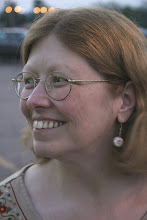
Meredith Sue Willis at West Virginia Book Festival, photo copyright by Dory Adams
We packed our bags, grabbed our cameras, and drove south. These spontaneous road trips often turn out to be some our best journeys because everything sort of unfolds as we go. No planning, no expectations – no disappointments. We stopped to buy a cane and a knee brace along the way, and on Saturday morning I hobbled through the book fair as best I could. We arrived in time to visit a few of the exhibits before the workshop started, so we browsed at the book tables of West Virginia University Press and Ohio University Press. Meredith Sue Willis’ workshop “Ten Strategies to Write Your Novel” was popular and well-attended, the room filled to capacity. What a pleasure it was to finally meet this wonderful writer who already seems like an old friend. After the workshop, Kevin took another stroll through the exhibition hall while I sat in the lobby to rest my knee. He returned with some unexpected finds: first editions of Chuck Kinder’s Snakehunter and Richard Currey’s The Wars of Heaven, both with dust jackets and in nice condition.
Taylor Books Cafe, photo copyright by Kevin Scanlon, used by permission
A trip to Charleston is not complete without a visit to Taylor Books, which is one of my favorite bookstores of all time. The bookstore, gallery annex, and café are in connected buildings with common floor space. Taylor Books has everything: a nice stock of fiction, nonfiction, poetry and children’s books; a large selection of magazines and periodicals; an art gallery; an art studio; a coffee shop with fresh baked scones and other pastries (baked by the owner, Ann Saville); tables and comfy chairs; and a knowledgeable staff. They even have squeaky wood floors to provide the ultimate bookstore browsing ambience. Best of all, Taylor Books values West Virginia’s writers by keeping their books in stock and on display – something you won’t find at a chain store (where the shelf-life of a newly published book these days, as Meredith Sue Willis said in her workshop, is less than that of yogurt).
View from gallery to bookstore and cafe at Taylor Books, photo copyright by Kevin Scanlon, use by permission
While I sipped a coffee, nibbled at a lemon bar, and perused a stack of books at my table in the coffee shop, Kevin shot the photographs for this week’s postcard from the road. We listened to the live music (Taylor’s has live music in the café Friday and Saturday evenings) and then made a few purchases. I knew I needed to get back home to Pittsburgh and take care of my knee, and that meant we were going to have to skip Jayne Anne Phillips’ reading on Sunday. The disappointment of that was eased by finding a brand new signed first edition of her 1994 novel Shelter at Taylor’s. That’s how it is with spontaneous journeys – you have to roll with it, and take great pleasure in the unexpected finds.
Taylor Books Cafe, photo copyright by Kevin Scanlon, used by permission
If your travels take you to Charleston, WV, be sure to visit Taylor Books, located at 226 Capitol Street. It’s definitely a destination in itself – and worthy of postcards from the road.
The publication of this week’s guest post will be delayed until Monday. Please check back tomorrow evening for a guest post by Slovenian photojournalist Misko Kranjec.
In the meantime, this gives me a chance to add a post about the recent Best Books of 2009 top ten list from Publisher’s Weekly. You’ve no doubt heard the outcry that not a single woman writer was named on the list. Kamy Wicoff, Founder and CEO of She Writes (of which I am a member), posted a wonderful editorial emphasizing her outrage at PW’s justification for coming up with a list that was not only exclusively male, but also 90% Caucasian.
There have been a flurry of posts at She Writes in response to Wicoff’s call to action, including one by writer Cathy Day about branding and book jackets as part of the literary gatekeeping.
In regard to the Publisher’s Weekly list, I can only shake my head in amazement that Jayne Anne Phillips’ Lark & Termite was not included. Phillips is the featured author in the winter 2009 issue of Appalachian Heritage, where you can read an excellent profile of her by another West Virginia writer, Meredith Sue Willis.
October 21st will mark the 40th anniversary of Jack Kerouac’s death. He’s one of those writers of an era, whose work stays with me over the decades. I’ve revisited his books many times since first reading On the Road in 1977. Jack Kerouac died on October 21, 1969 at the age of 47, and in May of 1983 I went to Lowell, Massachusetts to find his grave.
I’d traveled by train from Chicago to Boston to visit friends. Amtrak was having some sort of special fare. I don’t remember the details of the deal except that it allowed me to make several stopovers along the route so that I could also visit friends in Buffalo for a few days. It was a good enough bargain that I was able to afford a sleeper car roomette, a welcome luxury since most of the trip between Chicago and Buffalo was at night.
Cozy in my roomette, I watched out the window until dusk turned to darkness, amazed at how different the towns looked from my vantage point aboard the train – inside the lowered crossing gates with bells clanging and lights flashing where the tracks crossed streets and roadways. I had a new paperback with me, Joan Didion’sThe White Album, and after it got too dark to enjoy the scenery I lost myself in those pages – reading about the power of water in her essays “Holy Water” and “At the Dam” while my train rolled along dark rails at the southern edge of Lake Erie. The tracks ran closer to the lake at industrial areas, where mills still operated at nearly full blast, although the Manufacturing Belt was already corroding into what would become the Rust Belt. Despite my cozy nest in the roomette, I don’t think I slept much that night. I was homesick for California, and reading Didion’s essays for the first time. She had me hooked from the very first sentence of the first essay: “We tell ourselves stories in order to live.” She was writing about the end of an era, the end of the 1960s. It was the beginning of the 1980s then, and I was somehow saying goodbye to the 1970s on this journey as I headed further east, saying goodbye to California even though I’d left it behind the year before with the move to Chicago.
In Boston, I visited longtime friends Sherry and Jeff, who’d also lived in California for a few years after we’d all graduated from art school in Pittsburgh half a decade earlier. I’d been having a difficult time adjusting to the flatness of the Illinois landscape and needed a change of scenery. Needed to travel for a while. Needed hills and mountains. Needed to be near water that moved with oceanic tides. Chicago and Lake Michigan made me feel oddly claustrophobic, and I needed to escape the prairie land of the far southern suburbs where we lived.
Sherry and Jeff wanted to show me as much of New England as we could squeeze into a weekend drive, and we managed to see parts of New Hampshire and Maine. I saw the Atlantic Ocean for the first time on that trip. It’s ironic that I would see the Pacific Ocean first, after having grown up living much closer to the Atlantic. Looking at maps during our drive back to Boston, I spotted Lowell and requested that we go there to see the town where Jack Kerouac had grown up as a boy. It was where he was buried, and I wanted to try to find his grave.
Lowell looked exactly as I’d expected it to look, with brick mills along the Merrimac River. Despite there being many cemeteries in Lowell, Jeff instinctively turned the car into the correct one. We found a caretaker who asked, “Who yer lookin’ fer?” When I said Kerouac’s name, he went inside his gardener’s shed and brought out a mimeographed sheet of paper with directions to Kerouac’s tombstone. It pleased me that enough fans came seeking his gravesite that they’d printed directions.
There may be a different marker there now, but the small flat stone in the photograph above marked his grave then. We stayed only a few minutes. I no doubt would’ve lingered longer had I been alone. But, it was getting late in the day and we still had to drive back to Boston. It was just one stop on our journey, a side trip really, before getting back on the road again.
Leaving Boston by train, I thought about Kerouac. I’d read most of Kerouac’s work while living in California. One of my favorite pieces was “The Railroad Earth” in Lonesome Traveler, about working as a brakeman for the Southern Pacific Railroad while he lived in San Francisco. In the essay, Kerouac reminisces about Lowell while he’s working in the rail yards and riding the trains between San Francisco and San Jose. There’s something about traveling that makes us think about other places we’ve been and about the people we were with there. I was missing my husband whose job had kept him in Chicago while I was on this trip. In New York City I would change trains and then travel west to Pittsburgh for another stopover before returning to Chicago – toward what was our home for a brief while.
When I was younger I mostly measured time by weeks and months; only long chunks of time such as school grades and birthdays were measured in years. Now, I measure time in decades. I was barely out of my first decade when Kerouac died. As we quickly approach the end of our first decade in the 21st century, I’m already in my fifth decade, having surpassed the length of Kerouac’s short life. Rest in peace, Ti Jean. Your words live on as I continue speeding through my own lifetime.
News and Updates:
• Photojournalist Clyde Hare died last week. Hare came to Pittsburgh to work with Roy Stryker on the Pittsburgh Photographic Library Project and then made Pittsburgh his home for the next fifty years. The Pittsburgh Post-Gazette news obituary includes several of his images of Pittsburgh in the 1950s. Hare’s photographs are included in the collections of the Carnegie Museum of Art and at George Eastman House, among others.
• Carnegie Mellon University Press has announced the release of a new edition of Chuck Kinder’sThe Honeymooners: A Cautionary Tale as part of their Classic Contemporaries list. The new edition includes additional chapters and lost love letters which were not included in the original edition, as well as an introduction by Jay McInerney. Even though I have a signed first edition on my bookshelves, you can bet I’ll be buying and reading the new edition as soon as I can get my hands on it.
"Arrange what pieces come your way." ~ Virginia Woolf
About This Blog:
In This Light is a blog about the influence of images on writers and writing. Think of it as a place where imagery joins narrative, to see how things look through the light of words.
I live and write in Pittsburgh, PA and have a diverse background with degrees in photography and psychology, as well as an MFA in writing from Vermont College. I prefer to think of this as the winding path toward writing -- a journey where interests in image and human behavior converged as story.
My work has appeared or is forthcoming in Connotation Press, Now & Then: The Appalachian Magazine, The Santa Fe Literary Review, The Avery Anthology, Hamilton Stone Review, Blue Earth Review, Hobart, Slipstream, Forge, Word Riot, The Oklahoma Review, Common Ground Magazine, Shalla Magazine, and Paper Street. My story "Tests and Measurements" which appeared in Workers Write! Tales from the Clinic was nominated for a Pushcart Prize in 2009.
 Taylor Books in Charleston WV,
 Meredith Sue Willis at West Virginia Book Festival,
 Taylor Books Cafe,
 View from gallery to bookstore and cafe at Taylor Books,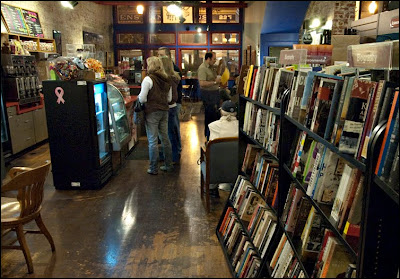


 Posts
Posts