Sunday, March 27, 2011

Looking Forward, Looking Back: “The Girl I Was, The Woman I Have Become”

Los Angeles Union Station courtyard, 1979
Copyright by Kevin Scanlon, all rights reserved,
used by permission

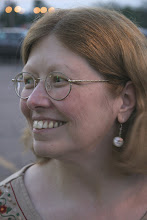
That's me in the picture, which was taken in 1979 at Union Station in Los Angeles. This photograph came to mind because I’ve been thinking about reminiscent narrators and journeys as part of the novel I’m writing. When I look at that image I see a girl headed into unknown territory, taking a break at a brief stop on the way to her destination – looking forward, not back.

Much has changed since those youthful days, including the story I might now tell about the journey north along the edge of the Pacific on the Coast Starlight. Back then, I was on the verge of making some important decisions, thinking only of the future. Now, I look back on that time with layers of knowledge that only experience and hindsight can provide to inform the past.

Writer Ellen Lesser, who was one of my mentors in the MFA program at Vermont College (now known as The Vermont College of Fine Arts), wrote an excellent essay on reminiscent narration. Lesser's article "The Girl I Was, The Woman I Have Become: Fiction's Reminiscent Narrators" originally appeared in The Writers Chronicle and has since been reprinted as one of the essays included in Words Overflown By Stars, which was edited by David Jauss (who was also one of my workshop teachers at VCFA). Ellen wrote the essay after noticing in workshop that "about half the submissions cried out for some added insight, of the sort a retrospective stance on their events could provide. The other half were set up as remembrances but never made particular use of the vantage point; some even appeared to forget, a few pages or paragraphs in, that their protagonists were gazing backward. It struck me that our developing writers had agonized over whether to narrate in past or present tense, in first or third person, but they'd approached this other crucial decision – the point in time from which the story gets told – at best casually, with little reflection." Lesser goes on to ask some important questions that every writer should consider about the use of reminiscent narration, and she looks at examples in the work of Kazuo Ishiguro, Alice McDermott, Edna O'Brien, Lynne Sharon Schwartz, Jane Smiley, and W. D. Wetherell. I highly recommend this book, which I also wrote about here.

In telling the story that goes with the photograph now, I might choose to reveal some things beyond the frame of that rainy morning in the station courtyard. I could flash forward and back by decades, layering in whatever is relevant to the story I want to tell. What I’d say now might be very different from what I’d have said in 1979. Even if you are familiar with that grand Art Deco station, and even if you’d once sat on that very same bench back in 1979, you couldn’t know what I was seeing or thinking about as I sat there smoking that cigarette. There are things even I couldn't know then that would add depth and meaning to the story – for instance that this would be the only train ride I'd take on the Coast Starlight. Or, that I'd soon give up cigarettes forever. Or, that I'd marry the guy who took this picture. It's all about framing and perspective. Distance, and finding exactly the right point in time for the telling.


Los Angeles Union Station, 1979
Copyright by
Kevin Scanlon, all rights reserved,
used by permission


Bookmark and Share

Sunday, March 20, 2011

Salvage: Rescue, Recover, Reclaim

"Antique Junk" (photo copyright by Dory Adams)

I’m deep into the mess that is my novel-in-progress, work which had been temporarily shelved more times than I care to remember. I’d fallen into a habit of working on it in fits and starts, waiting for larger blocks of writing time to immerse myself more fully in the writing. Guess what – it will never get finished that way. I finally realized that I have to make the time now, even if it’s only a few minutes each day.

Thanks to the help of Scrivener, I’m pulling together all the bits and pieces existent outside the written chapters: notebooks filled with details for scenes and chapters, character sketches, settings, timelines, lists of changes to be made, notes on structure and POV; index cards with research notes; file folders stuffed with newspaper clippings, post-it notes and scraps of paper; maps and photographs. This has allowed me to see the threads and shape of the story better, to see what is left to be done and not feel so overwhelmed by it all. It became clear to me as I worked with these scattered pieces that even during those times I’d claimed the novel was shelved, it never truly was – it was always with me, tugging at me to come back and finish the story.

It’s likely my posts here will be shorter in the coming months, and the focus will probably be geared more toward the writing process. This week, I’m sharing some interesting pieces I stumbled onto from around the web:

  • Cynthia Newberry Martin has a series of posts at her blog “Catching Days” on Jennifer Egan’s book, A Visit From The Goon Squad, which won the National Book Critics Circle Award. Cynthia’s post “Dear LA Times: This is a photograph of Jennifer Egan” takes the newspaper to task for running a photograph of Jonathan Franzen (who did not win this award) instead of a photo of Egan in their article. Additional posts explaining the photo choice can be found at LA Times’ blogs Jacket Copy and Readers’ Representative Journal.
  • One of my favorite books of all time is Tim O’Brien’s The Things They Carried. Back when I was teaching, I always managed to work at least one of his stories or essays into the syllabus. Here’s a link to a video of a short interview with O’Brien by Jeffrey Brown at PBS.

Bookmark and Share

Sunday, March 13, 2011

Only One Hour

“1 Hour Cleaning” copyright by Dory Adams

Time is on mind. Mainly in the context of the novel I’m writing, but also for various other reasons. I’ve been living in that space between two worlds – the fictional world of my characters, and the real world. It’s a good place to be because I’m always happy when the writing is going well, even if it means fumbling my way through the real world a bit distracted.

In the real world, the start of Daylight Savings Time is a date I look forward to each spring. After the darkness of winter, I’m happy to turn the clocks ahead. I don’t even mind losing that hour of sleep on the night of the time change. It seems a small price to pay for more daylight in the evening. Spring is on the way, and it won’t be long until I can set up shop in my summer office again.

In the fictional world, I’m bouncing around time across decades with my characters in two main story arcs, a “now” arc spanning the last few weeks of October 1989 and a “then” arc set in October 1963. I’m at my writing desk very early, getting in a few hours of work on my novel before going to my job. The morning darkness doesn’t bother me much. I don’t even notice daybreak because I’m lost in the writing. A timer on a lamp is set to shut off the light an hour before I need to leave for work – a reminder to pull myself away from the writing and get ready for the workday ahead.

For most people Daylight Savings Time isn’t such a big deal. Unless you’re a Hoosier, that is. Until 2006, some counties in Indiana switched to Daylight Savings Time while others remained on Standard Time. To further complicate timekeeping there, the state is divided by two time zones. I’m glad I never had to deal with that on a daily basis! It may only be one hour, but it makes a huge difference to me as the earth continues to spin on this trip around the sun.


In the News
  • I received an e-mail from Chuck Kinder today alerting me to the recent article in Pittsburgh City Paper by Bill O’Driscoll about Kinder: An Anthology of New Fiction. The anthology was put together as a gift to Chuck from his current graduate students as he recovers from serious health issues. Be well, my friend!


Bookmark and Share

Sunday, March 6, 2011

Muralist Douglas Cooper’s Pittsburgh: “Pinburg”


Pinburgh from Douglas Cooper on Vimeo.

A video titled “Pinburg” is making the Internet rounds these days. I have to share it here as this week’s image because it’s so fascinating to watch. The animated film takes us into one of Cooper’s monochromatic murals depicting Pittsburgh’s industrial landscape and hillside neighborhoods. No matter how hectic your day is, do yourself a favor and lift your spirits by taking time to watch the five-minute video (be sure to view it in full-screen mode with sound). In fact, maybe this would be a good way to start every day.

Douglas Cooper, a professor at Carnegie Mellon University’s School of Architecture, creates amazing charcoal-on-paper murals which emphasize Pittsburgh’s topography. The sidewalk stairways, which ascend to steep hillside neighborhoods and descend to the industrial river valleys, are somewhat reminiscent of M.C. Escher’s drawings. Cooper’s panoramas are filled with complex details for the viewer to discover – framed inside lighted windows, on porches, in passing trolleys and trains, and other surprising places within the scene. Many of these details show people engaged in activities, some of them based on memories of elderly Pittsburghers he has interviewed as part of his creative process.

Each time I see Cooper’s work on exhibition I’m transfixed, pulled into the scene in a very physical sense. Am I standing in the gallery, or am I standing inside the drawing? The scenes seem to be from multiple viewpoints and angles, yet merge together as vignettes that tell a story.

Doug Cooper’s first urban mural (created in 1992-93 as a work in progress at the Carnegie Museum of Art) is now on permanent display at the Senator John Heinz Regional History Center in Pittsburgh. Concept Art Gallery, in Pittsburgh’s Regent Square neighborhood, has smaller drawings by Cooper on display. To see more of Cooper’s work via the Concept Art Gallery website, click here. Cooper’s book, Steel Shadows: Murals and Drawing of Pittsburgh (University of Pittsburgh Press, 2000) is also still available in the paperback edition (144 pages, 11 x 9).

If you’ve read this far and still haven’t clicked on the “Pinburg” video, go ahead. Do it now. Indulge. Release your inner Yinzer.
Bookmark and Share

Sunday, February 27, 2011

The Year of Fog: The Final Missing Chapter

“The Great Highway at Ocean Beach, San Francisco, 1980”
Copyright by Kevin Scanlon, used by permission

Some books stay with you long after you’ve finished the last page. Michelle Richmond’s novel The Year of Fog, which I wrote about as one of my earliest blog posts here, is one of those books for me. I read it in 2009, two years after it was first published in 2007. Today the book is still going strong and was chosen as the 2011 selection for Silicon Valley Reads.

The working title for Richmond’s novel was “Ocean Beach” and it is often the imagery of San Francisco’s Ocean Beach, The Great Highway, and the Sutro Bath ruins that I connect with the characters of Abby and Emma. These were settings for important scenes in the book. They were also favorite spots of mine to explore when I lived in San Francisco, and they are places that tend to show up in my own fiction writing.

"Great Highway Parking at Ocean Beach, San Francisco, 1981"
Copyright by Kevin Scanlon, used by permission

Recently Richmond made the original ending, which she’d cut in the final manuscript edits, available as a download for e-readers as “Day 49: The Missing Final Chapter of The Year of Fog.” I want to be careful not to unintentionally reveal too much for those who have not yet read the book, so I’ll just say this: For readers, this is a unique opportunity to find out additional information about what happened to the characters; for writers, it’s an object lesson in editing.

Luckily for those of us who live far beyond the Bay Area, Michelle Richmond’s appearance earlier this month at the Morgan Hill Public Library was videotaped. Click on the video below for Richmond’s talk about the writing process, about research and editing, and about memory as a narrative device.


For a list of Richmond’s appearances at upcoming Silicon Valley Reads events for The Year of Fog, click here.

Around the Blogosphere:
  • Check out Kevin Scanlon’s photography and short essay “Mountain State Stories – Satori” in the most recent edition of The Photographers’ Railroad Page. This is the first feature in an occasional new series titled “Mountain State Stories.” In a recent message to RPP subscribers, Scanlon wrote, “I am pleased to announce that The Photographers’ Railroad Page will be under the direction of a new editor, Kevin N. Tomasic. Kevin will be soliciting and choosing new features for the site as well as making decisions on its general direction. The site will still be hosted by Lightsource Photo Imaging.”
  • At Photography in Place earlier this month, Edd Fuller ran several interesting posts on Edwards, Mississippi and photographer Walker Evans.


Bookmark and Share

Sunday, February 20, 2011

Waves of Trees in Snow, 2009: Tim Barnwell Print of the Month

"Waves of Trees in Snow, 2009" copyright by Tim Barnwell,
used by permission

(click on image for larger view)

I want this photograph. It reminds me of the more remote ridges and hollows in Pennsylvania where I grew up and of backcountry areas in West Virginia (the areas without mountaintop removal coal mining looming high above, ready to bury the valley with debris from the overburden and pollute the groundwater). Because this is one of Tim Barnwell’s photographs, I suspect it was taken further south in Appalachia. If you are a long time reader of my blog, you know that I've written about his work in the past, which you can read here and here.

Barnwell’s photographs capture the landscape of my home, of my roots. And when I look at the rise and fall of the ridges and the contours of the snowy mountains surrounding that homestead, I am transported. Joyce Carol Oates wrote in one of her novels (possibly it was in We Were the Mulvaneys) that we never escape the landscape of our childhood. She was talking about the emotional landscape as well as the physical landscape. Barnwell's image "Waves of Trees in Snow, 2009" evokes a strong emotional response for me: homesickness for how it feels to live nestled in the mountains; amazement at the pristine beauty; concern that this beauty will be lost; and admiration for Barnwell's artistry.

I have not yet had the pleasure of seeing Barnwell's work in exhibition, but I own a copy of one of his three books, On Earth's Furrowed Brow. Those images had the power to make me cry in the bookstore as I paged through the book for the first time. Although the price of a print of one of the images published there is beyond my means (Barnwell's photographs are included in the collections of several museums, including the Metropolitan Museum), Barnwell has launched a new "Print of the Month" program that is a wonderful opportunity for anyone who is serious about collecting fine art photography but has limited budget. "Waves of Trees in Snow, 2009" is the first photograph to be offered as a print of the month, and it is available until March 31, 2011 – which just happens to be the timeframe when I'll see another birthday come and go. Last year I received a Bill Scheele photograph of Levon Helm for my birthday. This year, I'm thinking a Barnwell photograph would be a nice addition to our collection.

Here is the description from Barnwell's website of how the new program works: "The Print of the Month Program is designed to introduce collectors to new, previously unpublished, images by master photographer and printer Tim Barnwell. We are able to offer special initial pricing, as these images are not available through galleries until after they rotate out of the Print of the Month (POM) program." These are limited edition photographs (a maximum of thirty photographic reproductions will be made), and each is mounted, matted, signed and numbered. The price is $295 during the time the print is offered as a print of the month selection. Print size is 11x14 (prints of this size are normally priced at $600 for unpublished images and $1200 for images published in his three books). For an additional $35, framing is available (black metal 16x20 frame, with Plexiglas). More details and ordering information are available at his website.

I'm looking forward to seeing what images will be offered in the future through the Print of the Month program, but this first one has the power to make me a little misty around the eyes, in the same way that the images in On Earth's Furrowed Brow do. It’s the topology that does it. In the prologue to An American Childhood, Annie Dillard writes, “When everything else has gone from my brain – the President’s name, the state capitals, the neighborhoods where I lived, and then my own name and what it was on earth I sought, and then at length the faces of my friends, and finally the faces of my family – when all this has dissolved, what will be left, I believe, is topology: the dreaming memory of land as it lay this way and that.”

Bio:
Tim Barnwell is a commercial and fine arts photographer based in Asheville, North Carolina. He is the author of three books, The Face of Appalachia, On Earth's Furrowed Brow, and Hands in Harmony. His fine art photography has been exhibited widely and his images have appeared in dozens of magazines including Time, Newsweek, Southern Accents, House Beautiful, American Craft, Outdoor Photographer, Sky and Telescope, US Air, Blue Ridge Country, U.S. News and World Report, Billboard, Travel South, American Style, Black & White Magazine, LensWork, and National Parks.

Photo Credit: "Waves of Trees in Snow, 2009" copyright by Tim Barnwell, used by permission

Bookmark and Share

Sunday, February 13, 2011

A Welcoming Light: Meetings With Remarkable Men

Kastl's in San Francisco, copyright by Kevin Scanlon,
all rights reserved, used by permission

The glow of warm lights from Kastl's is a sensory memory deeply encoded in my brain. That memory image can be triggered by associative senses, such as hearing certain songs that were on the jukebox there (Led Zeppelin’s “Fool in the Rain” or Elvis Costello’s “Alison” in particular). Long gone in reality, Kastl’s has a tendency to reemerge in my fiction writing – sometimes resurrected whole as a setting for a scene, and sometimes just a small detail from it will be used for an entirely different place. The night photograph shown above was taken on one of the final evenings it was open for business, and serves to confirm that the place truly existed and wasn’t simply invented by my imagination.

We rarely referred to Kastl’s by name, instead calling it “the diner” because the layout reminded us of the diners back east with a long counter and stools along the interior wall and deep booths against the window walls. The menu was far from diner food (brown rice and steamed kale were the standard side dishes instead of fries), but you could get a good burger and a real soda fountain coke, and the jukebox was usually playing.

What remains of Kastl’s is a series of memory images, such as the rainy evening a tow-truck driver stopped in for a takeout order, his truck double-parked out front with the yellow lights flashing. While he waited for his order, he sat at an upright piano along the back wall and played a classical piece I couldn’t identify, but in my stories it’s always something by Rachmaninoff.

Kastl’s closed when Bell Savings decided to take over the prime corner location at Sacramento Street and Presidio Avenue. That meant that Phil, the diner’s owner, lost his lease and was forced out of the space where he’d been in business for thirty years. In his sixties at the time and feeling too old to start over, he ended up retiring rather than trying to reestablish his business at a new location.

I still have one of the typewritten menus, a single sheet of paper folded in half, which I nabbed on our final visit. I come across it from time to time in a box of old keepsakes. It has a little grease stain on the front that I like to think is from the oil-based blue cheese dressing that came with the spinach salads.

I can’t remember the exact date it closed, although I could look it up in the journal I kept during those San Francisco years. I would’ve guessed 1980, but the movie listed on the Vogue’s marquee next door suggests it would’ve been 1979. If you look closely at the photograph (click on the image for a larger view), you can see Bell Savings wedged in between the theater and the diner, ready to expand and push the diner out of existence. Kastl’s was definitely a welcoming light, and a favorite meeting place for me with the remarkable man who photographed it.

Photo Credit: Kastl’s, copyright by Kevin Scanlon, all rights reserved, used by permission


Bookmark and Share